



 275 / 300

Furse, Wilford Road, Nottingham, NG2 1EB • Tel: +44 (0)115 964 3700 • Email:
enquiry@furse.com• Web:
www.furse.comTSC-0912 - 09.10.12
BS EN/IEC 62305-3
Guide to BS EN/IEC 62305
The rolling sphere method
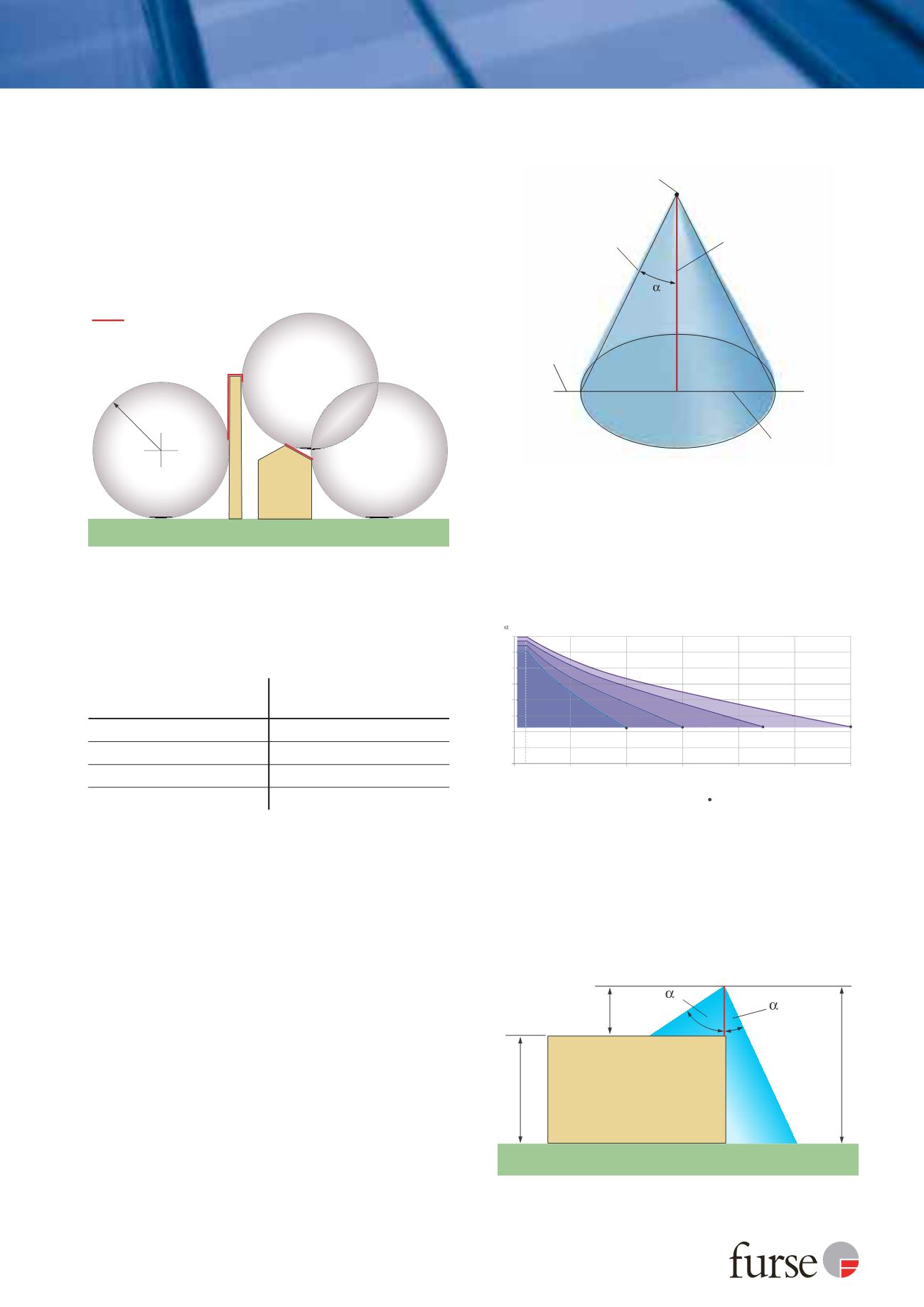
The rolling sphere method is a simple means of
identifying areas of a structure that need protection,
taking into account the possibility of side strikes to the
structure. The basic concept of applying the rolling
sphere to a structure is illustrated in Figure 15.
The rolling sphere method was used in BS 6651, the
only difference being that in BS EN/IEC 62305 there are
different radii of the rolling sphere that correspond to
the relevant class of LPS (see Table 8).
This method is suitable for defining zones of
protection for all types of structures, particularly
those of complex geometry.
The protective angle method
The protective angle method is a mathematical
simplification of the rolling sphere method. The
protective angle (a) is the angle created between the
tip (A) of the vertical rod and a line projected down to
the surface on which the rod sits (see Figure 16).
The protective angle afforded by an air rod is clearly a
three dimensional concept whereby the rod is assigned
a cone of protection by sweeping the line AC at the
angle of protection a full 360º around the air rod.
The protective angle differs with varying height of
the air rod and class of LPS. The protective angle
afforded by an air rod is determined from Table 2 of
BS EN/IEC 62305-3 (see Figure 17).
Varying the protection angle is a change to the simple
45º zone of protection afforded in most cases in
BS 6651. Furthermore the new standard uses the
height of the air termination system above the
reference plane, whether that be ground or roof level
(See Figure 18).
The protective angle method is suitable for simple
shaped buildings. However this method is only valid up
to a height equal to the rolling sphere radius of the
appropriate LPL.
Class of LPS
Rolling sphere radius
(m)
I
20
II
30
III
45
IV
60
Table 8: Maximum values of rolling sphere radius corresponding
to the Class of LPS
Figure 15: Application of the rolling sphere method
Rolling
sphere
radius
Air termination
required
Tip of air termination
Reference
plane
Protective
angle
Radius of
protected area
Height of an air
termination rod
above the reference
plane of the area
to be protected
h
A
C
Figure 16: The protective angle method for a single air rod
h
h
2
h
1
2
1
Figure 18: Effect of the height of the reference plane on the
protection angle
Figure 17: Determination of the protective angle
(BS EN/IEC 62305-3 Table 2)
0
0 2
10
20
30
h
(m)
I
II
III
Class of LPS
IV
40
50
60
10
20
30
40
50
60
70
80
˚
Note 1
Not applicable beyond the values marked with
Only rolling sphere and mesh methods apply in these cases
Note 2
h
is the height of air-termination above the reference plane of the area to be protected
Note 3
The angle will not change for values of
h
below 2m