



 278 / 300

Furse, Wilford Road, Nottingham, NG2 1EB • Tel: +44 (0)115 964 3700 • Email:
enquiry@furse.com• Web:
www.furse.comTSC-0912 - 09.10.12
Guide to BS EN/IEC 62305
BS EN/IEC 62305-3
Earth termination system
The earth termination system is vital for the
dispersion of lightning current safely and effectively
into the ground.
In line with BS 6651, the new standard recommends a
single integrated earth termination system for a
structure, combining lightning protection, power and
telecommunication systems. The agreement of the
operating authority or owner of the relevant systems
should be obtained prior to any bonding taking place.
A good earth connection should possess the following
characteristics:
Low electrical resistance between the electrode
and the earth. The lower the earth electrode
resistance the more likely the lightning current will
choose to flow down that path in preference to
any other, allowing the current to be conducted
safely to and dissipated in the earth
Good corrosion resistance. The choice of material
for the earth electrode and its connections is of
vital importance. It will be buried in soil for many
years so has to be totally dependable
The standard advocates a low earthing resistance
requirement and points out that it can be achieved
with an overall earth termination system of 10 ohms
or less.
Three basic earth electrode arrangements are used.
Type A arrangement
Type B arrangement
Foundation earth electrodes
Type A arrangement
This consists of horizontal or vertical earth electrodes,
connected to each down conductor fixed on the
outside of the structure. This is in essence the earthing
system used in BS 6651, where each down conductor
has an earth electrode (rod) connected to it.
Type B arrangement
This arrangement is essentially a fully connected ring
earth electrode that is sited around the periphery of
the structure and is in contact with the surrounding
soil for a minimum 80% of its total length (i.e. 20%
of its overall length may be housed in say the
basement of the structure and not in direct contact
with the earth).
Foundation earth electrodes
This is essentially a type B earthing arrangement. It
comprises conductors that are installed in the concrete
foundation of the structure. If any additional lengths
of electrodes are required they need to meet the same
criteria as those for type B arrangement. Foundation
earth electrodes can be used to augment the steel
reinforcing foundation mesh.
Separation (isolation) distance of
the external LPS
A separation distance (i.e. the electrical insulation)
between the external LPS and the structural metal
parts is essentially required. This will minimise any
chance of partial lightning current being introduced
internally in the structure.
This can be achieved by placing lightning conductors
sufficiently far away from any conductive parts that
have routes leading into the structure. So, if the
lightning discharge strikes the lightning conductor, it
cannot `bridge the gap’ and flash over to the
adjacent metalwork.
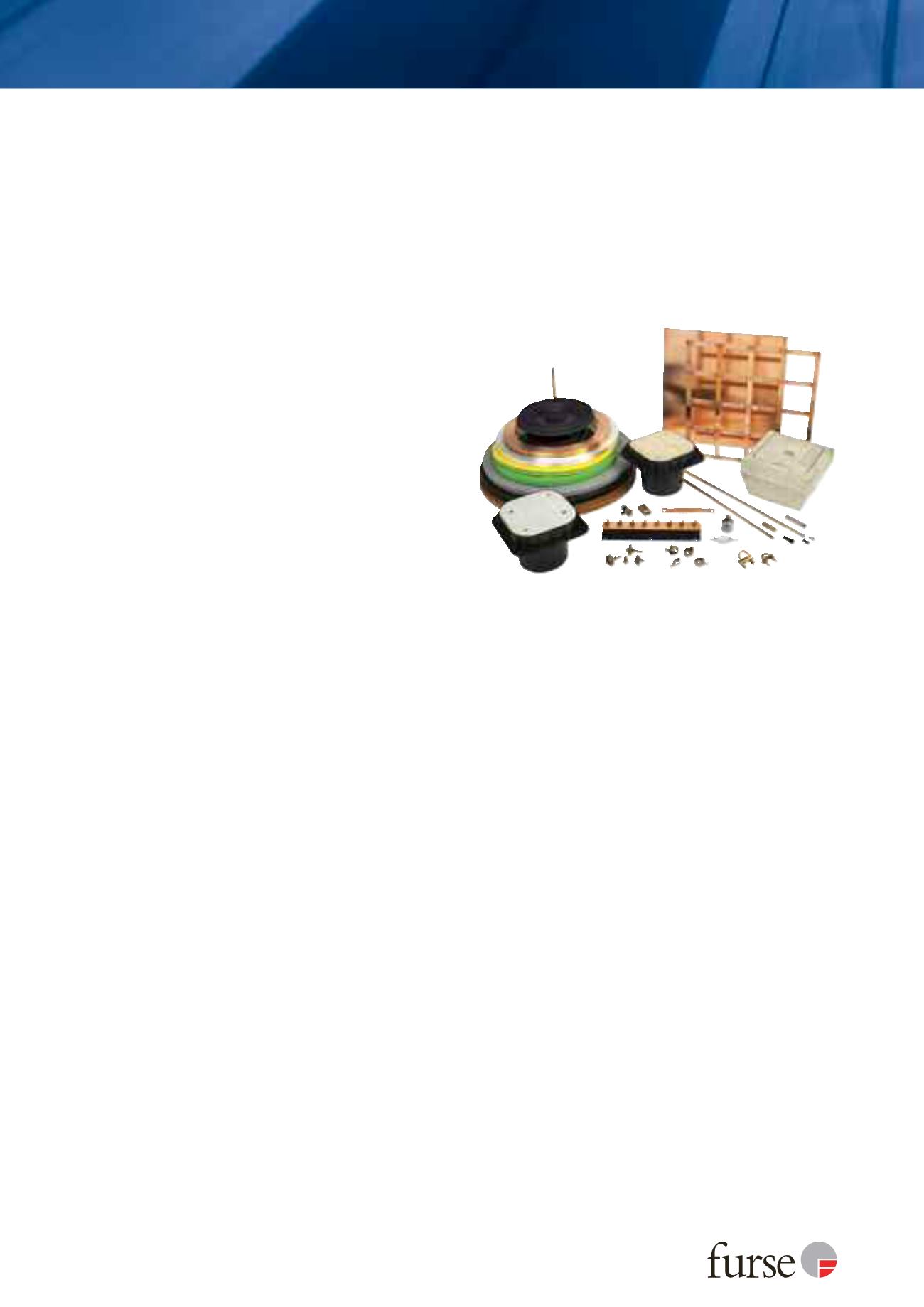
A sample of Furse high quality earthing components.
BS EN/IEC 62305 recommends a single
integrated earth termination system for a
structure, combining lightning protection,
power and telecommunication systems.