



 281 / 300

Furse, Wilford Road, Nottingham, NG2 1EB • Tel: +44 (0)115 964 3700 • Email:
enquiry@furse.com• Web:
www.furse.comTSC-0912 - 09.10.12
BS EN/IEC 62305-4
Guide to BS EN/IEC 62305
Indeed, as per BS EN/IEC 62305-3, an LPS system can no
longer be fitted without lightning current or
equipotential bonding SPDs to incoming metallic
services that have “live cores” - such as power and
telecoms cables - which cannot be directly bonded
to earth. Such SPDs are required to protect against
the risk of loss of human life by preventing
dangerous sparking that could present fire or electric
shock hazards.
Lightning current or equipotential bonding SPDs are
also used on overhead service lines feeding the
structure that are at risk from a direct strike. However,
the use of these SPDs alone “provides no effective
protection against failure of sensitive electrical or
electronic systems”, to quote BS EN/IEC 62305 part 4,
which is specifically dedicated to the protection of
electrical and electronic systems within structures.
Lightning current SPDs form one part of a coordinated
set of SPDs that include overvoltage SPDs - which are
needed in total to effectively protect sensitive
electrical and electronic systems from both lightning
and switching transients.
Lightning Protection Zones (LPZs)
Whilst BS 6651 recognised a concept of zoning
in Annex C (Location Categories A, B and C),
BS EN/IEC 62305-4 defines the concept of Lightning
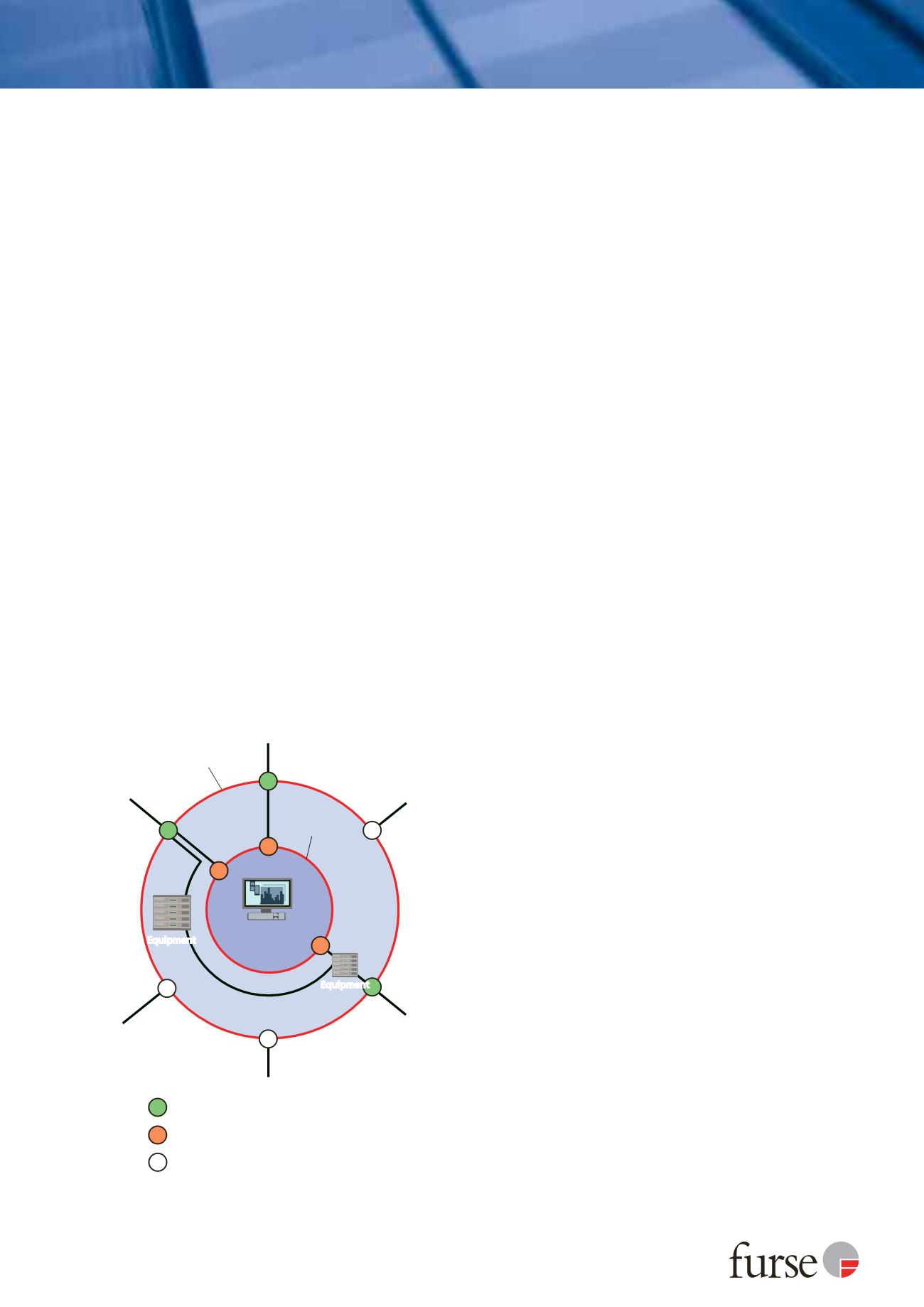
Protection Zones (LPZs). Figure 22 illustrates the basic
LPZ concept defined by protection measures against
LEMP as detailed within part 4.
Boundary
of LPZ 2
(shielded room)
Boundary
of LPZ 1
(LPS)
Antenna
Electrical
power line
Water pipe
Gas pipe
Telecoms
line
Mast or
railing
LPZ 2
B
B
B
B
LPZ 1
Critical
equipment
Equipment
SPD 1/2 - Overvoltage protection
Connected service directly bonded
SPD 0/1 - Lightning current protection
Equipment
LPZ
0
Figure 22: Basic LPZ concept - BS EN/IEC 62305-4
Within a structure a series of LPZs are created to have,
or identified as already having, successively less
exposure to the effects of lightning.
Successive zones use a combination of bonding,
shielding and coordinated SPDs to achieve a significant
reduction in LEMP severity, from conducted surge
currents and transient overvoltages, as well as radiated
magnetic field effects. Designers coordinate these
levels so that the more sensitive equipment is sited in
the more protected zones.
The LPZs can be split into two categories - 2 external
zones (LPZ
0
A
, LPZ
0
B
) and usually 2 internal zones
(LPZ 1, 2) although further zones can be introduced for
a further reduction of the electromagnetic field and
lightning current if required.
External zones
LPZ
0
A
is the area subject to direct lightning strokes
and therefore may have to carry up to the full
lightning current.
This is typically the roof area of a structure. The full
electromagnetic field occurs here.
LPZ
0
B
is the area not subject to direct lightning strokes
and is typically the sidewalls of a structure.
However the full electromagnetic field still occurs here
and conducted partial lightning currents and switching
surges can occur here.
Internal zones
LPZ 1 is the internal area that is subject to partial
lightning currents. The conducted lightning currents
and/or switching surges are reduced compared with
the external zones LPZ
0
A
, LPZ
0
B
.
This is typically the area where services enter the
structure or where the main power switchboard is
located.
LPZ 2 is an internal area that is further located inside
the structure where the remnants of lightning impulse
currents and/or switching surges are reduced compared
with LPZ 1.
This is typically a screened room or, for mains power, at
the sub-distribution board area.
Protection levels within a zone must be coordinated
with the immunity characteristics of the equipment to
be protected, i.e., the more sensitive the equipment,
the more protected the zone required.
The existing fabric and layout of a building may make
readily apparent zones, or LPZ techniques may have to
be applied to create the required zones.