



 273 / 300

Furse, Wilford Road, Nottingham, NG2 1EB • Tel: +44 (0)115 964 3700 • Email:
enquiry@furse.com• Web:
www.furse.comTSC-0912 - 09.10.12
BS EN/IEC 62305-2
Guide to BS EN/IEC 62305
BS EN/IEC 62305-2 is key to the correct
implementation of BS EN/IEC 62305-3 and
BS EN/IEC 62305-4. The assessment and
management of risk is now significantly more in
depth and extensive than the approach of BS 6651.
BS EN/IEC 62305-2 specifically deals with making a risk
assessment, the results of which define the level of
Lightning Protection System (LPS) required. While
BS 6651 devoted 9 pages (including figures) to the
subject of risk assessment, BS EN/IEC 62305-2 currently
contains over 150 pages.
The first stage of the risk assessment is to identify
which of the four types of loss (as identified in
BS EN/IEC 62305-1) the structure and its contents can
incur. The ultimate aim of the risk assessment is to
quantify and if necessary reduce the relevant primary
risks i.e.:
R
1
risk of loss of human life
R
2
risk of loss of service to the public
R
3
risk of loss of cultural heritage
R
4
risk of loss of economic value
For each of the first three primary risks, a tolerable risk
(
R
T
) is set. This data can be sourced in Table 7 of
IEC 62305-2 or Table NK.1 of the National Annex
of BS EN 62305-2.
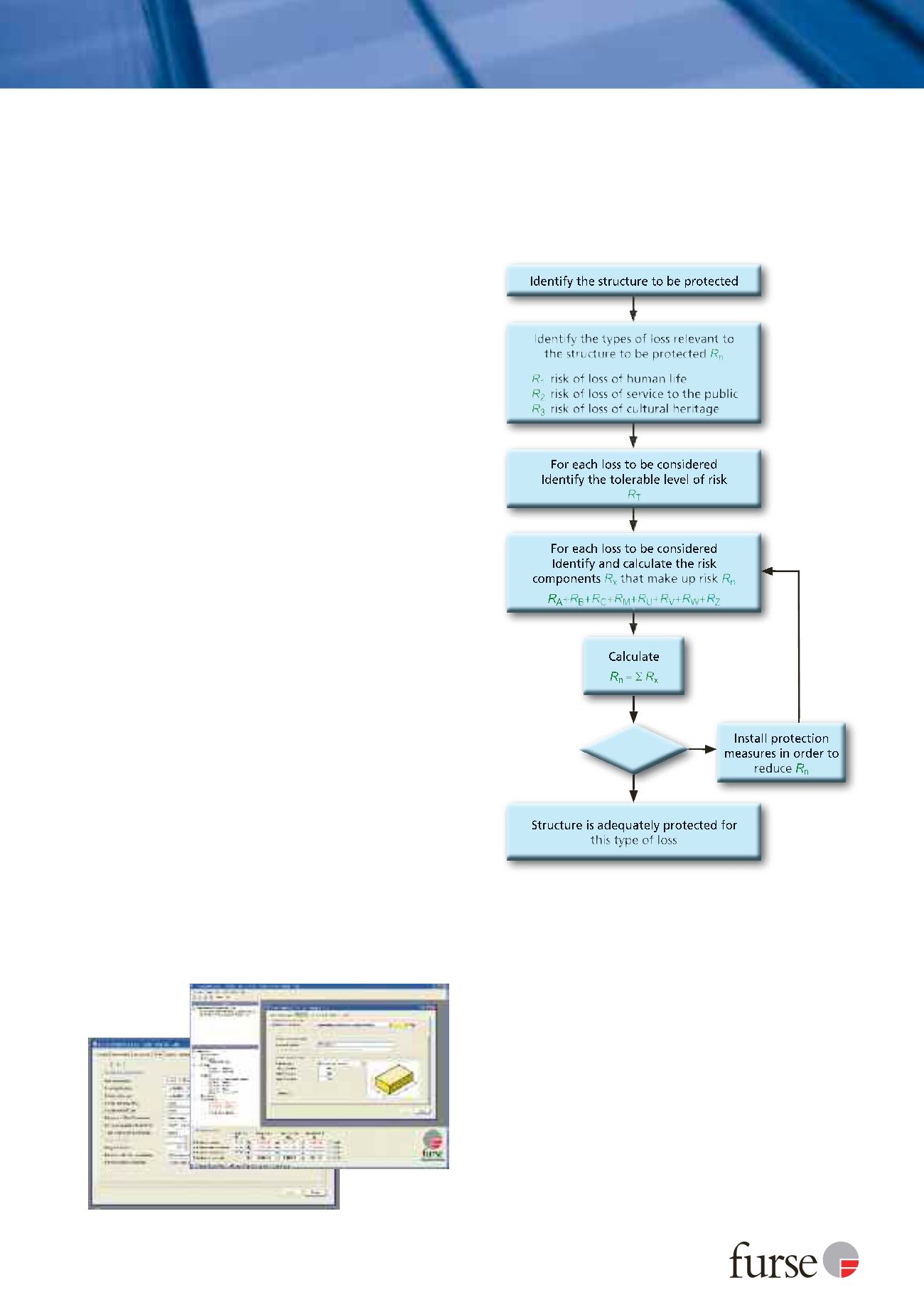
Each primary risk (
R
n
) is determined through a long
series of calculations as defined within the standard. If
the actual risk (
R
n
) is less than or equal to the tolerable
risk (
R
T
), then no protection measures are needed. If
the actual risk (
R
n
) is greater than its corresponding
tolerable risk (
R
T
), then protection measures must be
instigated. The above process is repeated (using new
values that relate to the chosen protection measures)
until
R
n
is less than or equal to its corresponding
R
T
.
It is this iterative process as shown in Figure 14 that
decides the choice or indeed Lightning Protection Level
(LPL) of Lightning Protection System (LPS) and Surge
Protective Measures (SPM) to counter Lightning
Electromagnetic impulse (LEMP).
StrikeRisk risk management
software
An invaluable tool for those involved in undertaking
the complex risk assessment calculations required by
BS EN 62305-2, StrikeRisk facilitates the assessment of
risk of loss due to lightning strikes and transient
overvoltages caused by lightning.
Quick & easy to use, with full reporting capability,
StrikeRisk automates risk assessment calculations and
delivers results in minutes, rather than the hours or
days it would take to do the same calculations
by hand.
Contact Furse for more details about StrikeRisk.
BS EN/IEC 62305-2 Risk management
NO
YES
R
n
<
R
T
Figure 14: Procedure for deciding the need for protection
(BS EN/IEC 62305-1 Figure 1)