



 268 / 300

Furse, Wilford Road, Nottingham, NG2 1EB • Tel: +44 (0)115 964 3700 • Email:
enquiry@furse.com• Web:
www.furse.comGuide to BS EN/IEC 62305
Introduction
TSC-0912 - 09.10.12
BS EN/IEC 62305
Lightning protection
standard
The BS EN/IEC 62305 Standard for lightning protection
was originally published in September 2006, to
supercede the previous standard, BS 6651:1999.
For a finite period, BS EN/IEC 62305 and BS 6651
ran in parallel, but as of August 2008, BS 6651 has
been withdrawn and now BS EN/IEC 62305 is the
recognised standard for lightning protection.
The BS EN/IEC 62305 standard reflects increased
scientific understanding of lightning and its effects
over the last twenty years, and takes stock of the
growing impact of technology and electronic systems
on our daily activities. More complex and exacting
than its predecessor, BS EN/IEC 62305 includes four
distinct parts - general principles, risk management,
physical damage to structures and life hazard, and
electronic systems protection.
These parts to the standard are introduced here. In
2010 these parts underwent periodic technical review,
with updated parts 1, 3 and 4 released in 2011.
Updated part 2 is currently under discussion and is
expected to be published in late 2012.
Key to BS EN/IEC 62305 is that all considerations for
lightning protection are driven by a comprehensive
and complex risk assessment and that this assessment
not only takes into account the structure to be
protected, but also the services to which the structure
is connected. In essence, structural lightning protection
can no longer be considered in isolation, protection
against transient overvoltages or electrical surges is
integral to BS EN/IEC 62305.
Structure of BS EN/IEC 62305
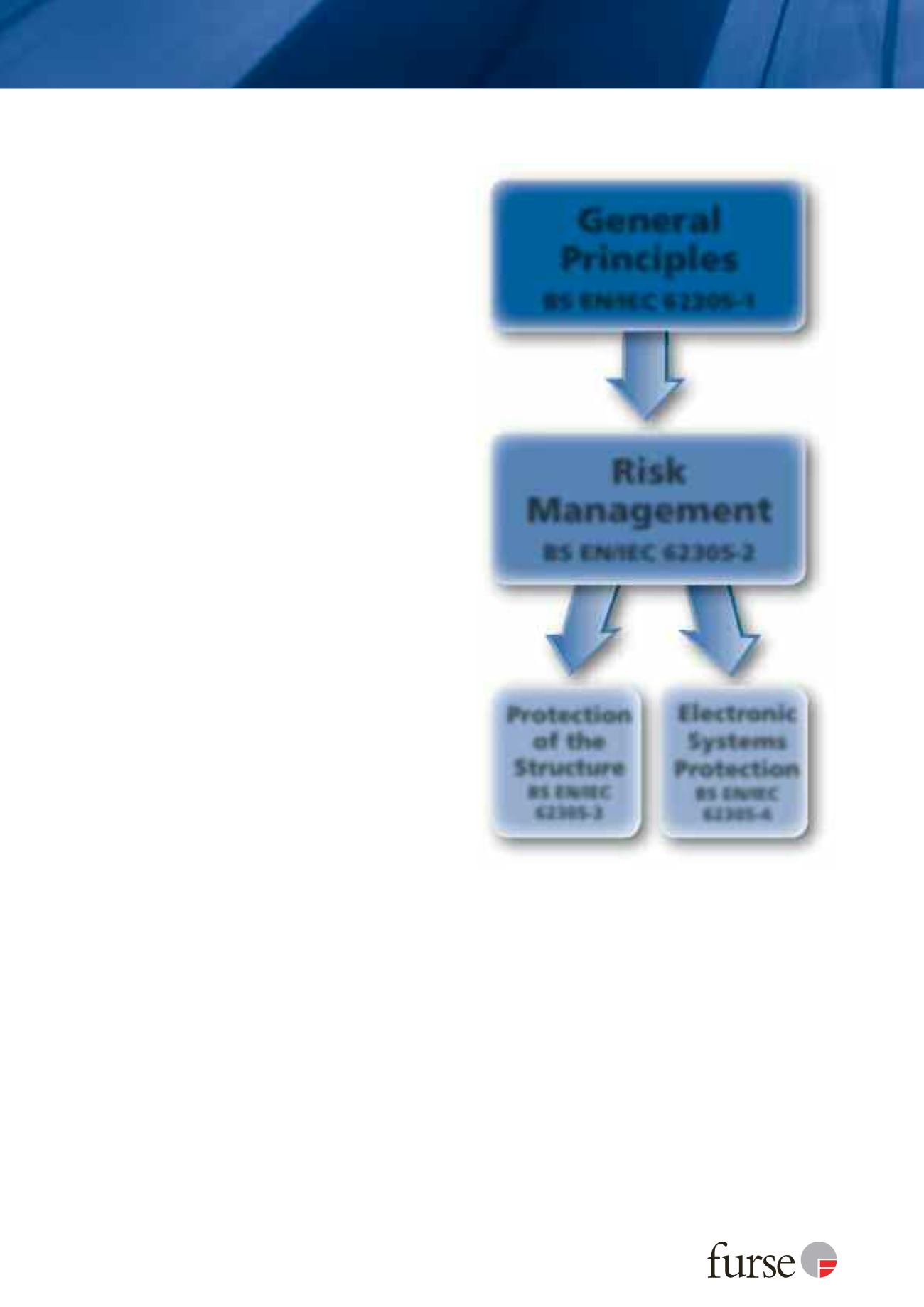
The BS EN/IEC 62305 series consists of four parts,
all of which need to be taken into consideration.
These four parts are outlined below:
Part 1: General principles
BS EN/IEC 62305-1 (part 1) is an introduction to the
other parts of the standard and essentially describes
how to design a Lightning Protection System (LPS) in
accordance with the accompanying parts of the
standard.
Part 2: Risk management
BS EN/IEC 62305-2 (part 2) risk management approach,
does not concentrate so much on the purely physical
damage to a structure caused by a lightning discharge,
but more on the risk of loss of human life, loss of
service to the public, loss of cultural heritage and
economic loss.
Part 3: Physical damage to structures and
life hazard
BS EN/IEC 62305-3 (part 3) relates directly to the major
part of BS 6651. It differs from BS 6651 in as much that
this new part has four Classes or protection levels of
LPS, as opposed to the basic two (ordinary and
high-risk) levels in BS 6651.
Part 4: Electrical and electronic systems
within structures
BS EN/IEC 62305-4 (part 4) covers the protection of
electrical and electronic systems housed within
structures. It embodies what Annex C in BS 6651
conveyed, but with a new zonal approach referred to
as Lightning Protection Zones (LPZs). It provides
information for the design, installation, maintenance &
testing of a Lightning Electromagnetic Impulse (LEMP)
protection system (now referred to as Surge Protection
Measures - SPM) for electrical/electronic systems within
a structure.
General
Principles
BS EN/IEC 62305-1
Risk
Management
BS EN/IEC 62305-2
Protection
of the
Structure
BS EN/IEC
62305-3
Electronic
Systems
Protection
BS EN/IEC
62305-4