



 272 / 300

Furse, Wilford Road, Nottingham, NG2 1EB • Tel: +44 (0)115 964 3700 • Email:
enquiry@furse.com• Web:
www.furse.comTSC-0912 - 09.10.12
Guide to BS EN/IEC 62305
BS EN/IEC 62305-1
Lightning Protection Zones (LPZ)
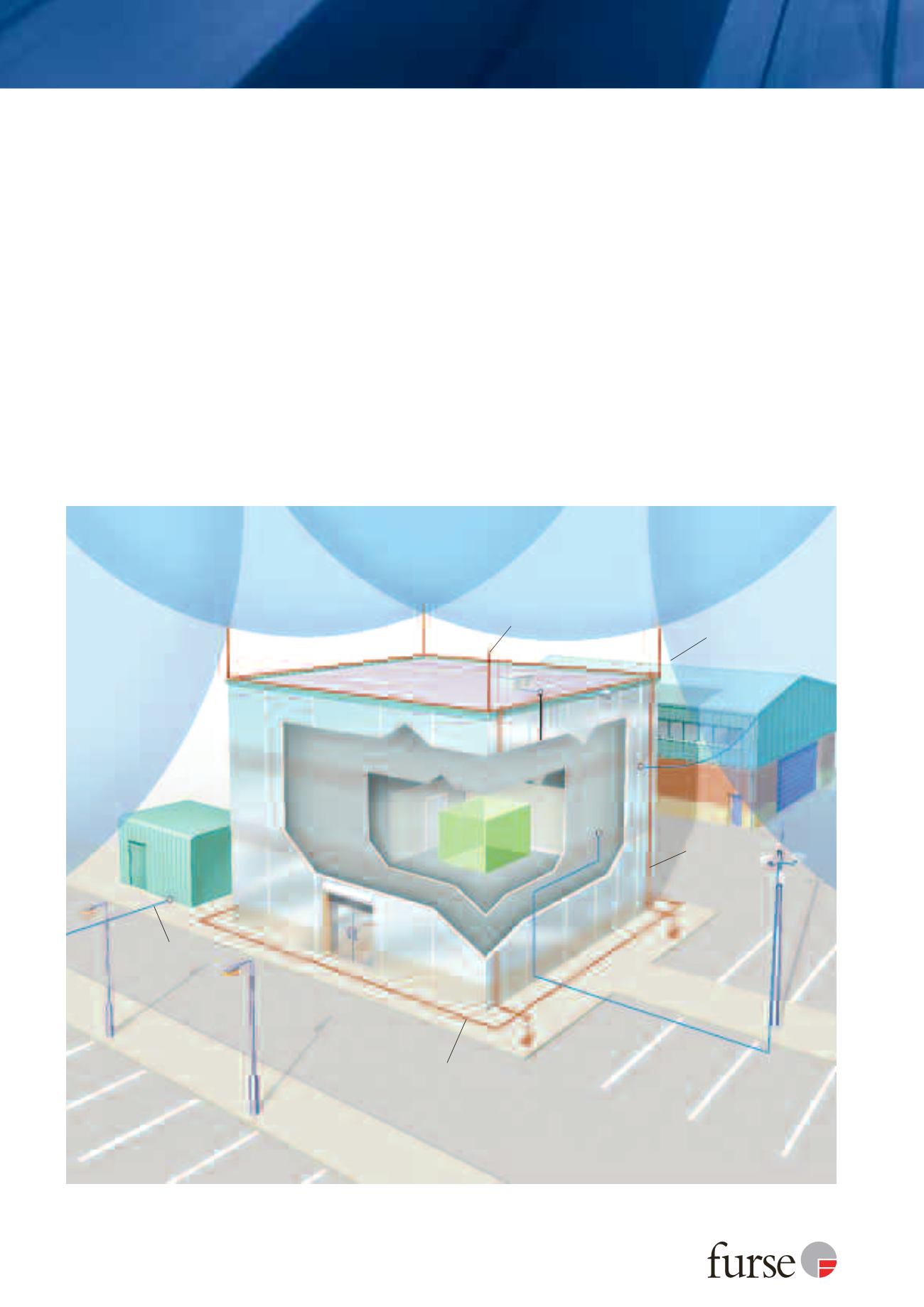
The concept of Lightning Protection Zones (LPZ)
was introduced within BS EN/IEC 62305
particularly to assist in determining the protection
measures required to establish protection
measures to counter Lightning Electromagnetic
Impulse (LEMP) within a structure.
The general principle is that the equipment requiring
protection should be located in an LPZ whose
electromagnetic characteristics are compatible with the
equipment stress withstand or immunity capability.
The concept caters for external zones, with risk of direct
lightning stroke (LPZ
0
A
), or risk of partial lightning
current occurring (LPZ
0
B
), and levels of protection
within internal zones (LPZ 1 & LPZ 2).
LPZ
0
A
LPZ
0
B
LPZ 1
LPZ 2
LPZ 3
LPZ
0
B
Air termination network
Direct flash, full lightning
current, full magnetic field
No direct flash,
partial lightning
or induced current,
full magnetic field
Equipotential bonding
by means of SPD
No direct flash, partial
lightning or induced
current, damped
magnetic field
No direct flash,
induced currents,
further damped
magnetic field
Rolling sphere radius
Down conductor
network
Earth termination network
SPD
0
B
/1
SPD
0
B
/1
SPD
0
B
/1
SPD
0
B
/1
Figure 13: The LPZ concept
In general the higher the number of the zone (LPZ 2;
LPZ 3 etc) the lower the electromagnetic effects
expected. Typically, any sensitive electronic equipment
should be located in higher numbered LPZs and be
protected against LEMP by relevant Surge Protection
Measures (‘SPM’ as defined in BS EN 62305:2011).
SPM were previously referred to as a LEMP Protection
Measures System (LPMS) in BS EN/IEC 62305:2006.
Figure 13 highlights the LPZ concept as applied to
the structure and to SPM. The concept is expanded
upon in BS EN/IEC 62305-3 and BS EN/IEC 62305-4.
Selection of the most suitable SPM is made using the
risk assessment in accordance with BS EN/IEC 62305-2.