



 278 / 413

6/8
Software
Unity Pro software
Small/Medium/Large/Extra Large
Function block libraries
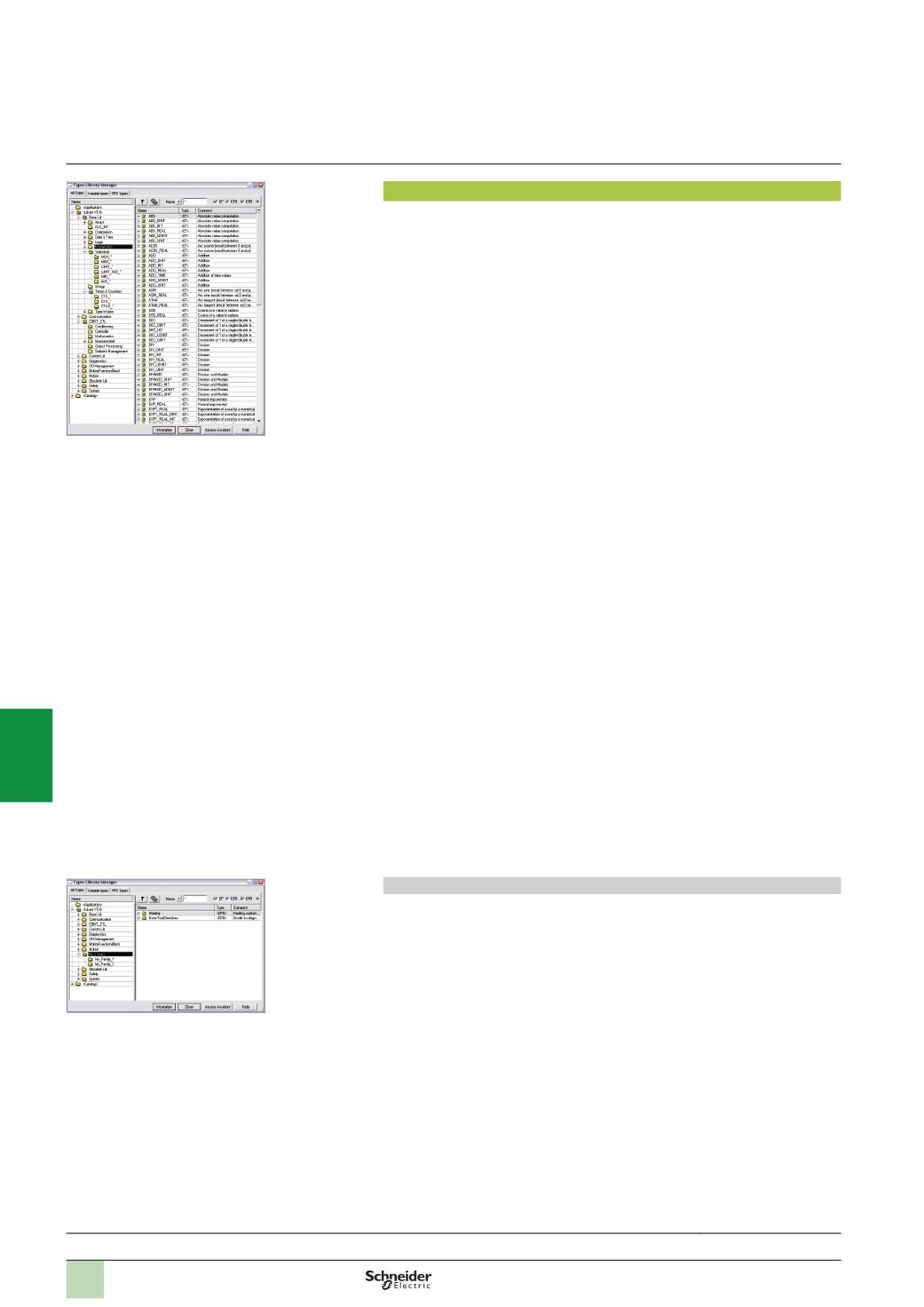
The function and function block libraries manager contains all the elements provided
with Unity Pro software. Functions and function blocks are organized into libraries,
which themselves consist of families. Depending on the type of PLC selected and the
processor model, users will have a subset of these libraries available to write their
applications. However, the “Base Lib” library contains a set of functions and function
blocks, the majority of which compatibility is independent of the platforms. In particular,
it contains the blocks compliant with IEC 61131-3.
The “Base Lib” library is structured into families:
b
Timers and counters
b
Process control on integers
b
Table management
b
Comparison
b
Date and time management
b
Logic processing
b
Mathematical processing
b
Statistical processing
b
Character string processing
b
Type-to-type data conversion
The “Base Lib” library, which covers standard automation functions, is supplemented
by other, more application-specific libraries and platform-specific functions:
b
Communication library
,
providing an easy means of integrating communication
programs from PLCs with those used by HMIs from the PLC application program.
Like other function blocks, these EFBs can be used in all languages to exchange
data among PLCs or to deliver data to be displayed on an HMI.
b
Process control library
.
The CONT_CTL library can be used to set up process-
specific control loops. It offers controller, derivative and integral control functions
plus additional algorithms, such as EFBs for calculating mean values, selecting a
maximum value, detecting edges or assigning a hysteresis to process values, etc.
b
Diagnostics library
,
which can be used to monitor actuators and contains EFBs
for active diagnostics, reactive diagnostics, interlocking diagnostics, permanent
process condition diagnostics, dynamic diagnostics, monitoring of signal groups, etc.
b
I/O management library
,
providing services to handle information exchanged
with hardware modules (formatting data, scaling, etc.)
b
Motion Function Blocks library
,
containing a set of predefined functions and
structures to manage motion controlled by drives and servo drives connected on
CANopen
b
Motion library
for motion control and fast counting
b
System library
,
which provides EFBs for the execution of system functions,
including: Evaluation of scan time, availability of several different system clocks,
SFC section monitoring, display of system state, management of files on the
memory cartridge of the Modicon M340 processor, etc.
b
Finally, a library named “obsolete”, containing all function blocks used by legacy
programming software needed to perform application conversions.
Management of user standards
Users may create libraries and families in order to store their own DFBs and DDTs.
This enhancement allows users to take advantage of programming standards
adapted to their needs, along with version management. This means that it is
possible to:
b
Check the version of the elements used in an application program against those
stored in the library
b
Perform an upgrade, if necessary
Functions
(
continued)
Selection guide:
page 6/2
Standard function block libraries
User libraries
2
1
3
4
5
6
7
8
9
10