



 250 / 300

TSC-0912 - 09.10.12
Furse, Wilford Road, Nottingham, NG2 1EB • Tel: +44 (0)115 964 3700 • Email:
enquiry@furse.com• Web:
www.furse.comESP PV Series
NEW
Enhanced protection (to BS EN 62305) offering low let-through voltage
further minimizing the risk of flashover creating dangerous sparking or
electric shock
Repeated protection in lightning intense environments
The varistor based design eliminates the high follow current (
I
f
)
associated with spark gap based surge protection
Compact, space saving design
Indicator shows when the protector requires replacement
Remote signal contact can indicate the protector’s status through
interfacing with a building management system
Features and benefits
Combined Type 1 and 2 tested protector (to BS EN 61643) for a
Photovoltaic PV solar panel system that is on a building where a
structural Lightning Protection System (LPS) is employed, for
equipotential bonding. For use at boundaries up to LPZ
0
A
to
protect against flashover (on the DC side of the DC-AC inverter)
through to LPZ 2 to protect the PV system from damage.
WBX D4
Weatherproof enclosure
Accessories
Protector should be installed in
the main distribution board with
connecting leads of minimal
length. The protector should
be fused and is suitable for
attachment to a 35 mm top hat
DIN rail.
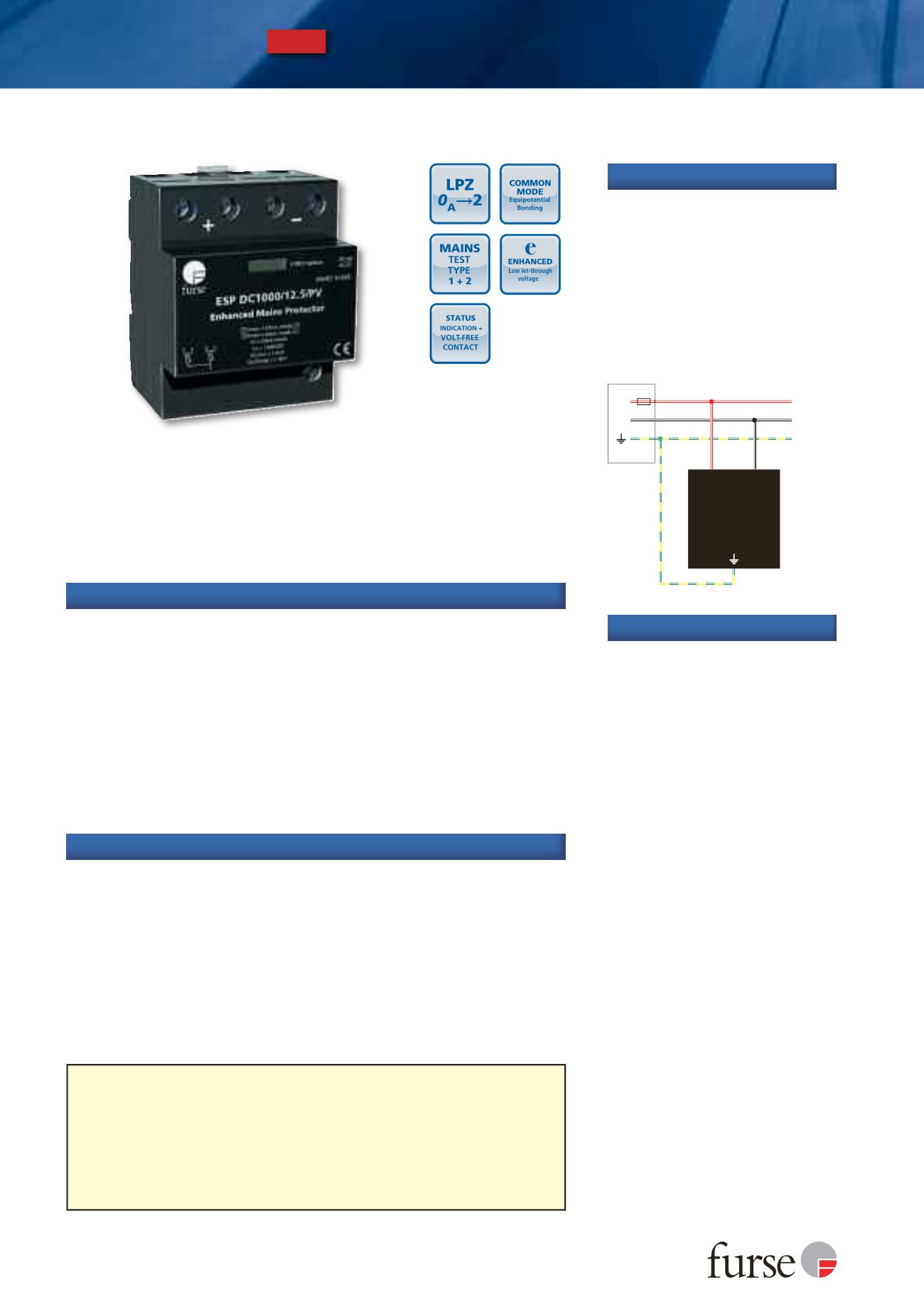
Install in parallel to the DC supply
of the DC-AC inverter via fuses.
Installation
Use on the DC side of the DC-AC inverter for protection against partial
direct or indirect lightning strikes. ESP Type 1 AC mains protectors (e.g.
ESP 415/III/TNS) are further required at the AC side of the DC-AC inverter.
Application
From PV Panel
+
-
+
-
+
-
ToDC
inputof
inverter
IMPORTANT
The primary purpose of lightning current or equipotential bonding mains Type 1 Surge
Protective Devices (SPDs) is to prevent dangerous sparking caused by flashover to protect
against the loss of human life. In order to protect electronic equipment and ensure the
continual operation of systems, transient overvoltage mains Type 2 and 3 SPDs such as the
ESP M1 or ESP D1 Series are further required, typically installed at downstream sub-distribution
boards feeding sensitive equipment. BS EN/IEC 62305 refers to the correct application of mains
Type 1, 2 and 3 SPDs as a coordinated set.
For further information, please refer to the Furse Guide to BS EN 62305 Protection
against Lightning.