



 305 / 413

6/35
Functions
(
continued)
Software
Unity Pro software
User-definable process control
Processing branches
Parameter-setting (selection of the functions to be used) of the control loop profiles
can be used to adapt the algorithm to the process to be controlled.
Process value processing
Process values can be processed either in the standard way or externally.
b
Standard processing: The user can access the following functions: Filtering,
setting process value limits, function generator with scaling, management of alarms
on threshold overshoot, totalizer and simulation of the measured value.
b
External processing: This means there can be a process value PV at the controller
input which has been processed outside the control loop. This is a handy solution if
calculation of the process value requires special or customized functions.
Setpoint processing
Depending on the type of loop selected, it is possible to opt for one of the following
4
types of setpoint: Ratio setpoint, selection setpoint, simple setpoint (“remote” with
scaling) or setpoint programmer.
In the case of the controller with 3 simple loops or the secondary loop (in an
autoselective loop), only the simple setpoint and the setpoint programmer can be
used.
Feed Forward processing
Feed Forward processing can be used to compensate for a measurable disturbance
as soon as it appears. This open loop processing anticipates the effect of the
disturbance. It features the “Leading” function (lead/lag phase).
Controller and command processing
The controller can be chosen from the following 6 types: Self-tuning PID, controller in
discrete mode with 2 or 3 states, hot/cool controller (PID or self-tuning model) or Split
Range controller (PID or self-tuning model).
Output processing
There are 3 types of output which can be processed: Analog output, servomotor
output or PWM output. Whatever the type of output, the command calculated by the
controller crosses a gradient limiter and a limiter whose upper and lower limits are
used to define the output variation range.
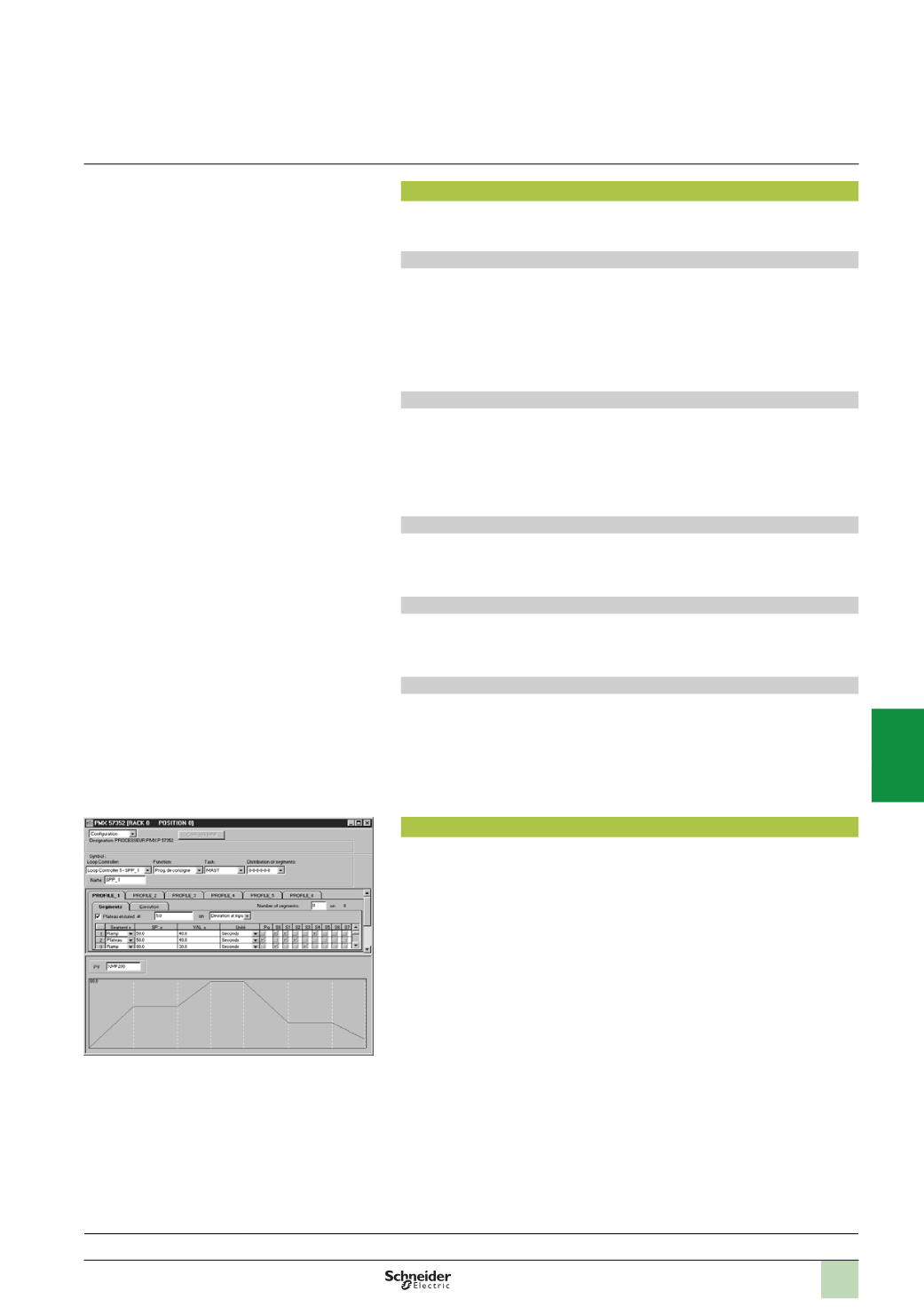
Setpoint programmer
The setpoint programmer offers a maximum of 6 profiles consisting of a total of
48
segments. It is thus possible to create various programmer/segment configurations,
e.g. one programmer with 48 segments, 6 programmers with 8 segments or one
programmer with 24 segments plus one programmer with 16 segments and one
programmer with 8 segments, etc.
Each segment is configured as either a ramp or dwell step. It is characterized by:
b
The setpoint to be reached
b
The duration of the segment or slope of the segment (if it is a ramp)
A profile can be executed once, a certain number of times or looped continuously. In
addition, the concept of a guaranteed dwell step means the time is only counted
down if the measurement is definitely within the specified range.
Presentation:
pages 6/32 …
2
1
3
4
5
6
7
8
9
10