



 304 / 413

6/34
Presentation
(
continued)
,
functions
Software
Unity Pro software
User-definable process control
Presentation
(
continued)
Premium
TSX P57 2
p
4
M
/
2634
M
/
3
p
4
M
/
3634
M
/
454
M
/
4634
M
/
554
M
/
5634
M
/
6634
M
processors offer the possibility of configuring 10, 15, 20 or 30 control channels for
continuous or semi-continuous processes.
The process control functions offered by these processors are particularly suitable for:
b
Sequential processes requiring auxiliary process control functions such as
packaging machines, surface treatment machines, presses, etc.
b
Simple processes such as metal treatment furnaces, ceramic ovens, refrigeration
units
b
Servocontrol systems or mechanical process control where the sampling time is
critical, such as torque control, speed control, etc.
Premium processors include the following characteristics:
b
Each configurable process control channel can be used to manage 1 to 3 loops
depending on the type of loop selected
b
Process control processes can be inserted in the overall architecture of a site,
thanks to the integration of the PLC in different communication networks
b
Process control-related calculations are performed in floating point arithmetic
expressed in physical units
Description and characteristics
:
TSX P57
pp
4
/
pp
34
M
processors (see pages 1/6
to 1/11).
Functions
User-definable control loops
Premium processors can be used to set up 10 to 30 process control channels, each
adopting one of the following 5 control profiles:
b
Process-type loop: Loop with a single controller
b
Controller with 3 simple loops: Controller used to increase the capacity of the
number of loops
b
Autoselective loop, also called secondary loop: Consisting of 2 loops in parallel
with an algorithm for selecting the output
b
Cascaded loop: Consists of 2 dependent loops (the master loop output is the slave
loop setpoint)
b
Setpoint programmer: Consisting of a maximum of 6 composite profiles, with a
total of 48 segments
As the channels are independent, configuration of 10 channels can be used for
example to obtain:
b
30
simple loops
b
5
setpoint programmers, each associated with 5 control loops
b
2
setpoint programmers and 8 process loops
The various loops are characterized by:
b
Their different algorithms
b
5
processing branches (process value, setpoint, Feed Forward, controller and
output processing)
b
Calculation functions (gain, filtering, square root, etc.) defined using parameters
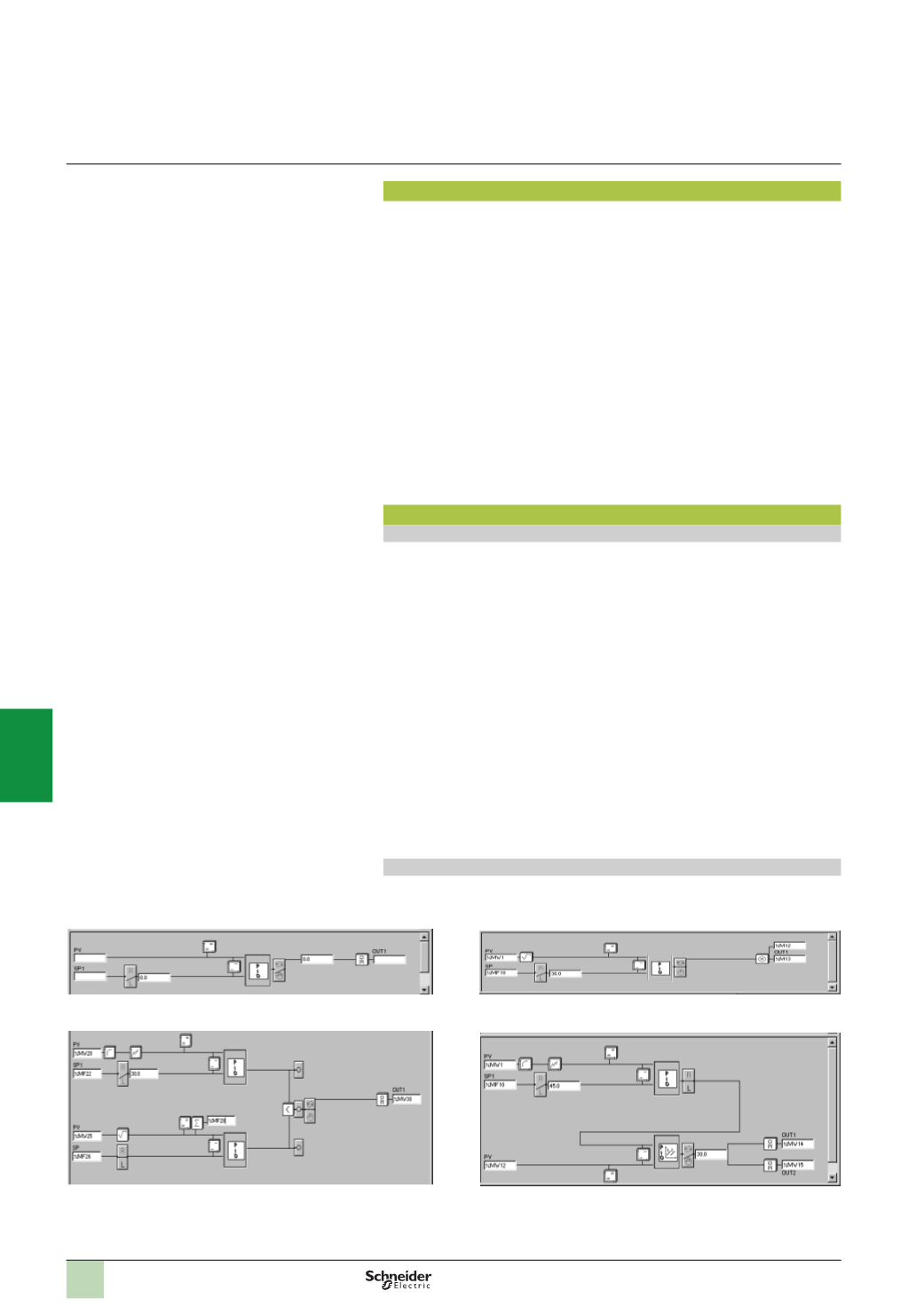
Types of control loop
Predefined algorithms can be defined by the user and are represented as shown
below:
Process loop
Simple loop
Autoselective loop
Cascaded loop
2
1
3
4
5
6
7
8
9
10