


 329 / 356

D-81
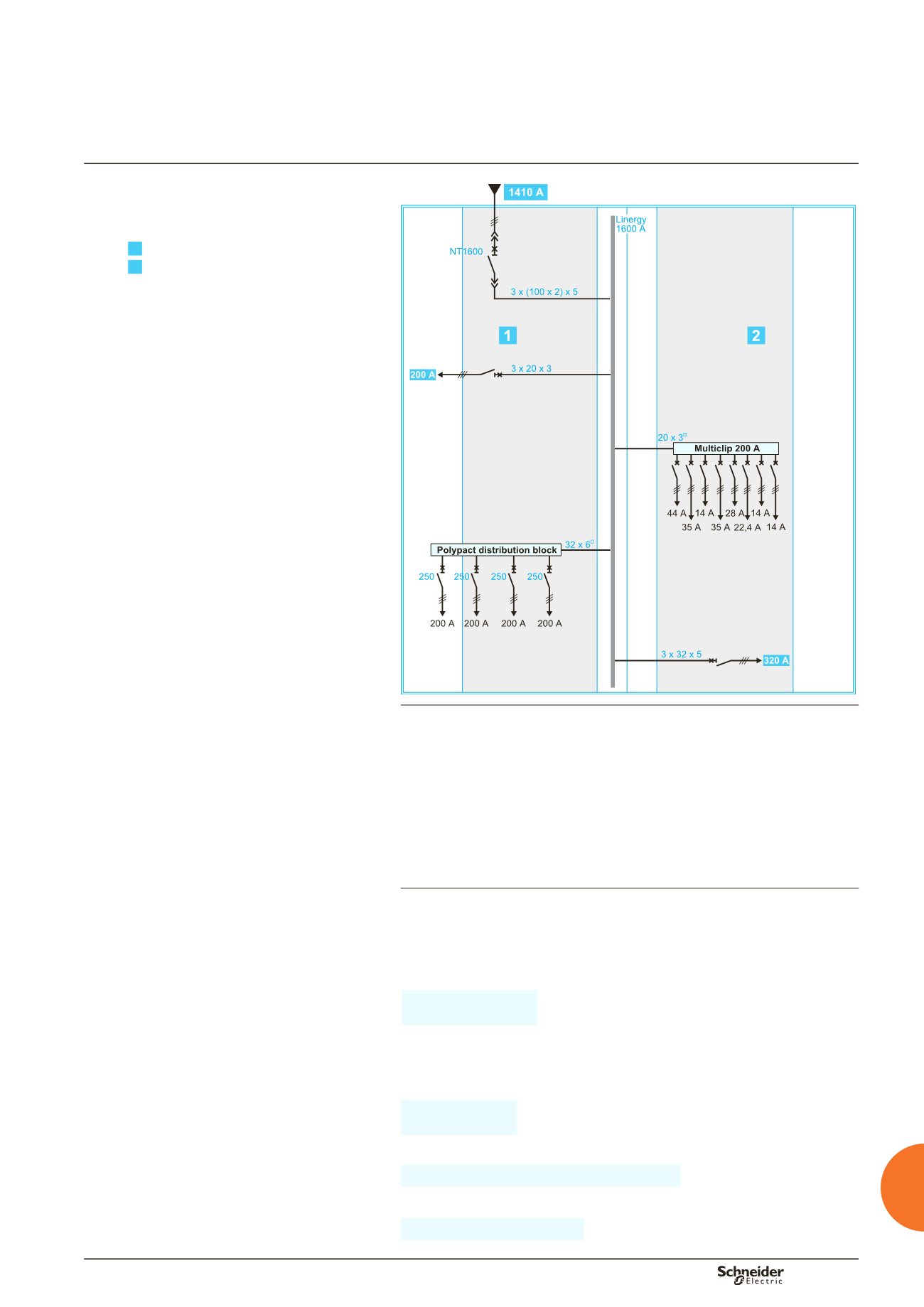
Two cubicles with busbar compartment, 800 mm
wide, 1000 mm deep, two 300 mm wide ducts, IP30
Diversity factor: 0.7
Ambient temperature around the switchboard: 35 °C
Cubicle
1
: P(W) of device zone = 580 W
Cubicle
2
: P(W) of device zone = 180 W
DD383958
Application of the diversity factor
In the configuration below, the standardised diversity factor (K div.) for a total of 14
outgoing circuits is 0.6, i.e. 60 % of In for each outgoing circuit.
Merlin Gerin prefers a more conservative approach and therefore divides the
installation into four main circuits:
NSX250
200 AMulticlip: 8 outgoers
V
K div. = 0.7
Polypact: 4 outgoers
V
K div. = 0.8
NSX400.
1 NSX250 + 1 Multiclip 200 A + 1 Polypact + 1 NSX400
V
4 outgoers, i.e. a diversity
factor of 0.8.
As a result, the current flowing in each circuit is at least 70 % and up to 80 % of In.
b
b
b
b
Calculation of the power dissipated by
devices in the incoming cubicle
Dissipated power of the NT1600 indicated by the manufacturer: 460 W.
The power dissipated by the connections is approximately 30 % of the device P(W):
0.3 x 460 = 138 W.
Power of circuit breaker + connections = 460 + 138 = 598 W at 1600 A.
For I² (the Watts are proportional to the square of the current) at 1410 A (In of the
incoming device):
Dissipated power of the NSX250 indicated by the manufacturer: 42 W.
Dissipated power of the connections: 0.3 x 42 = 12.6 W.
Power of circuit breaker + connections = 42 +12.6 = 54.6 W at 250 A.
For 200 A (the tested value):
Dissipated power of the Polypact and its four NSX250 circuit breakers:
Sum of the dissipated power in the incoming cubicle:
NSX250
NSX NSX NSX NSX
NSX400
4 x 35 W (same calculation as above) = 140 W
P(W) = 405 + 35 +140 =
580 W
598
1600
2
---------- 1410
2
405 W =
×
54 6,
250
2
-------- 200
2
35 W =
×
Additional informations
Thermal management
of switchboards
Example
Thermal characteristics of
switchboards