



 509 / 582

BETA Monitoring
Monitoring of Plants and Devices
5
TT5 2 EMERGENCY-STOP modules
14/13
Siemens ET B1 · 10/2008
14
■
More information
Category of safety-related parts of control systems according to CEN/TC 114 EN 954-1
Scope
The scope of the EC Directive Machines is no longer restricted
to industrial machinery, but now covers virtually all machines
used in all areas of commercial and private trade and industry
and applies to all
•
Stationary
•
Movable
•
Hand-held
•
Mobile
•
Machine tools and processing machines
•
Prime movers and production machines
•
Compressors
•
Operating and packaging machines
•
Machines in underground mining
•
Earthmoving machines and harvesters
•
Hoisting equipment
•
Floor conveyors
•
Machines for lifting persons
•
Plants
•
Interchangeable equipment, such as snow ploughs and
mountable sweeping devices.
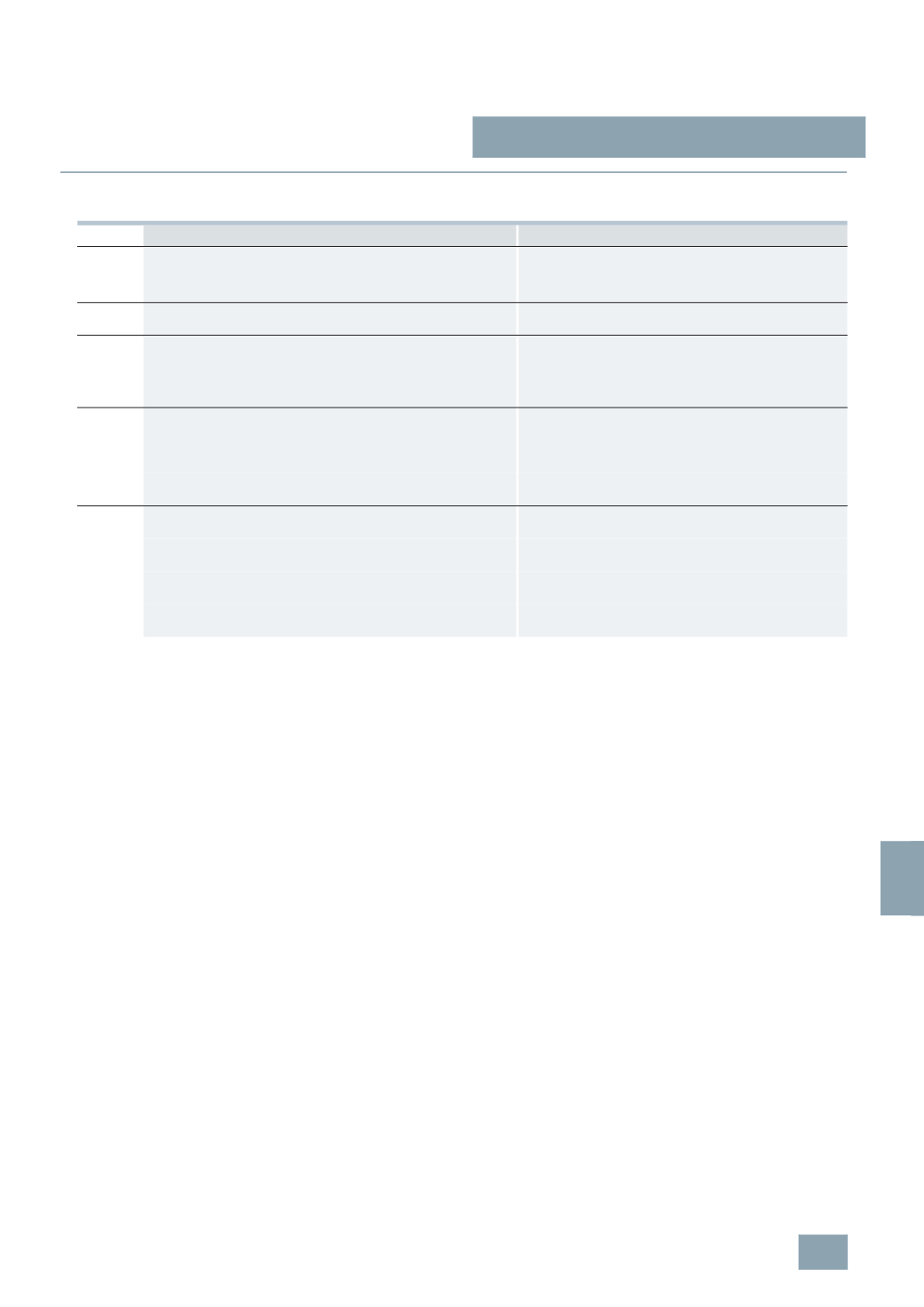
Category Summary of requirements
System behavior
B
The safety-related parts of machine control systems and/or their protective
devices and their components must be state of the art and designed,
selected, assembled and combined such that they can withstand the
expected influences.
The occurrence of a fault can lead to the loss of the safety
function. Some faults remain undetected.
1
The requirements of B must be fulfilled. Use of proven safety components
and principles.
As described for category B, but with a higher level of
safety-related reliability
2
The requirements of B must be fulfilled. Use of proven safety principles.
The safety functions must be tested at suitable intervals using the machine
control system.
Note: What is considered suitable depends on the application and the type
of machine.
The occurrence of a fault can lead to the loss of safety function
between testing intervals. The fault is detected by the test.
3
The requirements of B must be fulfilled. Use of proven safety principles.
The control systems must be designed so that:
If a single fault occurs, the safety function is always maintained.
Some, but not all, faults are detected.
An accumulation of undetected faults may lead to the loss
of the safety function.
a) A single fault in the control system does not lead to the loss of the
safety function(s) and
b) Wherever possible, the single fault is detected by the appropriate
means, which must be state-of-the-art.
4
The requirements of B must be fulfilled. Use of proven safety principles.
A control system must be designed so that:
If faults occur, the safety function is always maintained. The faults
are detected in time to prevent the loss of the safety function.
a) A single fault
in the control system does not lead to the loss of the
safety function(s)
and
b) Wherever possible, a single fault is detected at or before the next
request for the safety function
or
c) If b) is not possible, that an accumulation of faults does not lead to the
loss of the safety function.
© Siemens AG 2008