




 167 / 439

2010
CA08103002Z-EN
www.eaton.comElectronic overload relay 6/19
2010
CA08103002Z-EN
Description
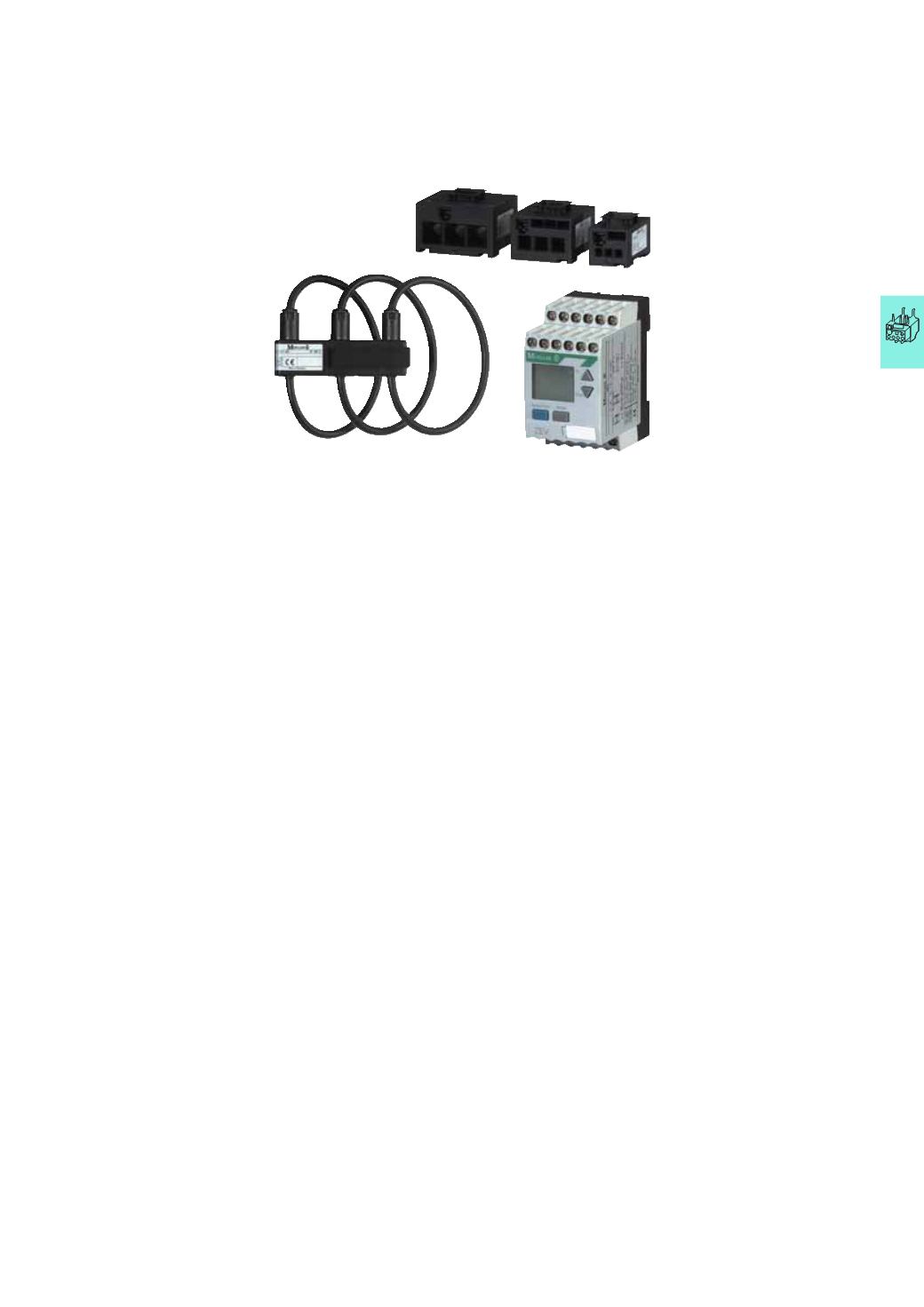
ZEV – electronic overload relay for motor currents from 1 – 820 A
General
Technological advances require
completely new approaches:
the application of newly developed
sensor systems and tripping units has
made motor protection considerably
simpler and more cost-effective.
All Z overload relays perform the
expected standard functions:
protection in the event of a phase
failure, overload or current imbalance.
In addition to these tasks, the innova-
tive ZEV motor protectionsystem can
do much more today:
Application
Even the most severe starting situa-
tions can be dealt with by the ZEV
motor-protective system. The
enhanced tripping classes (up to
CLASS40) provide reliable protection
for motors with starting times of up to
1
second. Protection for any motor
starting situation can be optimally
set by preselecting one of the eight
tripping classes between 5 and
40
seconds.
Ground faults are quickly detected
with the external core-balance trans-
former. The integrated thermistor
connection makes it possible to
expand the relay into a motor protec-
tion system.
Handling
The LCD display guides users through
setting menus and ensures easy,
user-friendly operation.
In the event of an error, the display
shows the cause of the error and
allows for quick fault detection.
The 05-06 and 07-08 parameterizable
auxiliary switches make it possible
to implement additional signalling
indications.
They can each be assigned one of the
following functions:
•
Early warning of overload
•
Ground fault
•
Thermistor tripping
•
Internal fault
Engineering
The multi-voltage module adapts
automatically to different voltages of
24 - 240
V, 50/60 Hz and 24 - 240 VDC,
enabling its flexible use with all
popular control voltages.
Mounting
Current sensors enable the innovative
ZEV motor protection system to be
used also for small motors. With large
motor currents and cable cross-
sections, the sensor cables are simply
wound round the feeder cables.
This eliminates the need for main
current wiring requiring the time-
consuming adaption of cables to an
additional device, as well as mounting
plate drilling. Instead of this, the
sensor is simply attached with a
Velcro fastener.
This saves mounting time and
expense. The volume of 58 times less
than conventional transformers
enables the saving of valuable
mounting space in the control panel.
ZEV