



 253 / 327

TECHNICAL INFORMATION
Technical information
Wire Basket
| 253
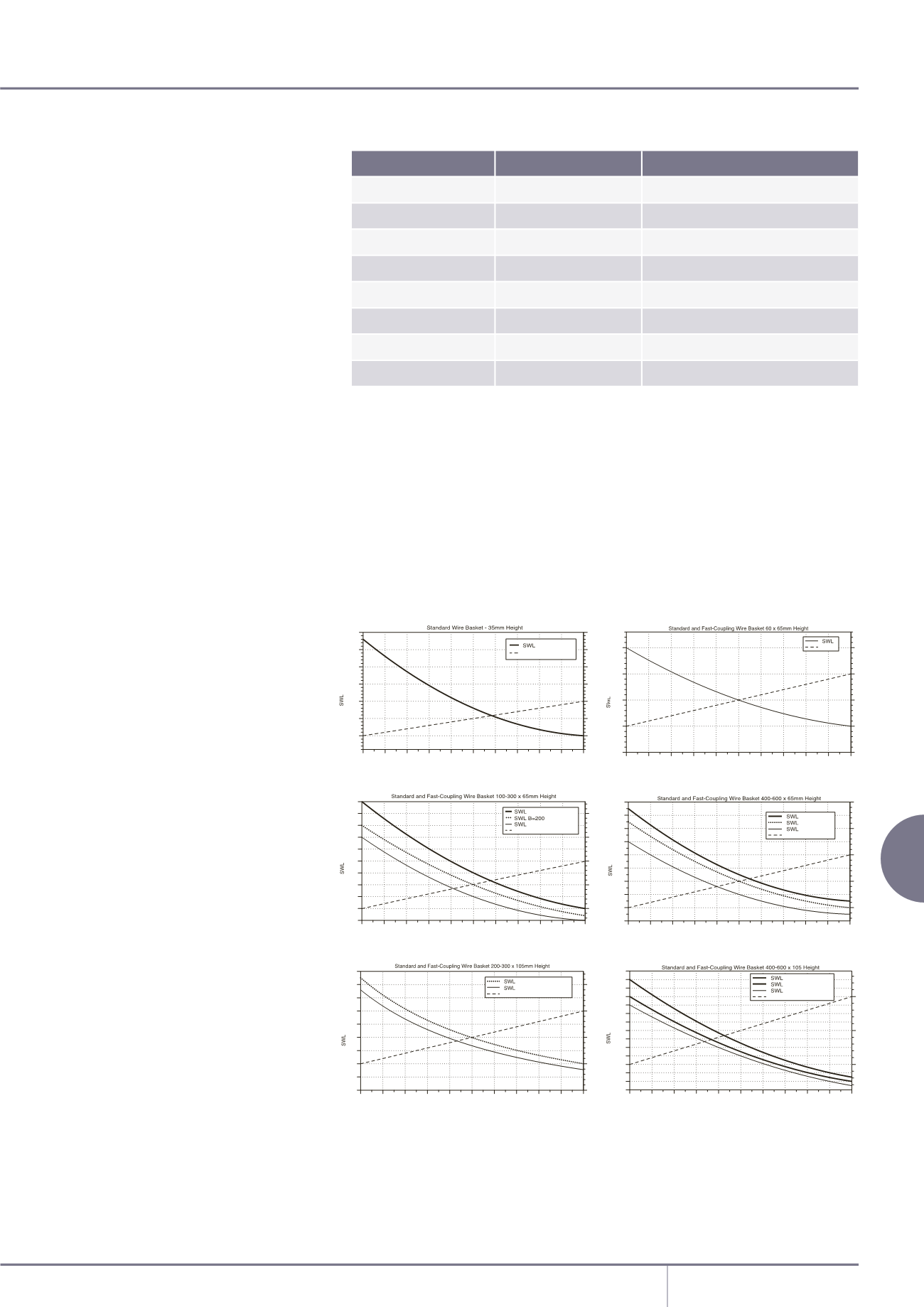
Safe working load (SWL)
The safe working load (SWL) is the maximum load which can be applied during normal use,
without danger. Therefore, the workload shall always be less than the SWL.
The SWL of our products are calculated in accordance with IEC 61537. For any further
information contact our Technical Team in +44 (0)1424 856688.
To show the installation designer the level of ventilation allowed for the cable tray, the IEC 61537
standard established that the manufacturer has to inform of the percentage of the base 'free'
(without material, in solid cable trays this means the "degree of perforation").
16
Atmospheric Corrosion
Atmospheric corrosion happens when
metal is exposed to liquids, solids or gases,
Humidity, salt corrosive gases and dirt are
its main factors. Atmospheric corrosion
takes place in open air conditions, areas
with poor ventilation and marine
environments.
Saline corrosion happens when a metallic
surface is exposed to dierent saline
concentration levels forming a galvanic
pile. At times where the surface is exposed
to the lowest degree of saline
concentration this will then behave as an
anode for the corrosion to take place.
Chemical Corrosion
Chemical corrosion happens when metal is
directly exposed to chemical solutions.
Depending on the concentration of the
solution, contact time , cleaning frequency
and ambient temperature the level of
corrosion will be higher or lower.
Galvanic Corrosion
Galvanic corrosion is the most common
type of corrosion, and happens when two
dierent metals are in contact with one
another. When two dierent metals come
into contact a small galvanic par is created,
as one metal acts as an anode the other
acts as a cathode. The metal with the most
negative reduction potential shall oxidise
whilst the metal with the most positive
charge shall have less corrosion.
Storage Conditions
The product must be stored in a dry and
well ventilated area. The product must not
be stored outside even in low humidity
conditions.
Resistance to corrosion
Free Base Area
Base size
Classification
Free base area
60
Z
More than 90%
100
Y
Over 80% and up to 90%
150
Y
Over 80% and up to 90%
200
Y
Over 80% and up to 90%
300
Y
Over 80% and up to 90%
400
Y
Over 80% and up to 90%
500
Y
Over 80% and up to 90%
600
Y
Over 80% and up to 90%
10
15
20
25
30
B=300
B=100..150
Def
20
25
30
35
40
45
50
55
60
65
70
d (m)
1.0
1.1
1.2
1.3
1.4
1.5
1.6
1.7
1.8
1.9
2.0
(Kg/m)
Def (mm)
5
10
15
20
25
300x105
200x105
Def
20
30
40
50
60
70
80
90
100
110
d (m)
1.0
1.1
1.2
1.3
1.4
1.5
1.6
1.7
1.8
1.9
2.0
10
15
20
25
30
B=600
B=500
B=400 Def
30
40
50
60
70
80
90
100
110
120
d (m)
1.0
1.1 1.2
1.3 1.4
1.5 1.6
1.7 1.8
1.9 2.0
10
15
20
B=600
B=500
B=400
Def
50
60
70
80
90
100
110
120
130
140
150
160
170
180
190
d (m)
1.0
1.1
1.2
1.3
1.4
1.5
1.6
1.7
1.8
1.9
2.0
5
10
15
20
25
Def
5
10
15
20
25
d (m)
1.0
1.1
1.2
1.3
1.4
1.5
1.6
1.7
1.8
1.9
2.0
10
15
20
25
30
35
40
Def
10
15
20
25
30
35
40
d (m)
1.0
1.1
1.2
1.3
1.4
1.5 1.6
1.7
1.8
1.9
2.0
Def (mm)
(Kg/m)
Def (mm)
(Kg/m)
Def (mm)
(Kg/m)
Def (mm)
(Kg/m)
(Kg/m)
Def (mm)