


 671 / 759

Technical Hotline
+44 (0)1268 563720
671
CABLE MANAGEMENT
PERIMETER AND
DISTRIBUTION
Egatube Conduit
Technical
Fixing
Egatube round conduit is fixed in the normal way with saddles
or clips. (Various types of saddles are available). The distance
between saddles should not exceed that stated in the following
table, or less in hot temperatures.
NOMINAL CONDUIT
SIZE (mm)
MAXIMUM DISTANCE BETWEEN
SUPPORTS (M)
HORIZONTAL
VERTICAL
Not exceeding 16
0.75
1.00
Exceeding 16 but not
exceeding 25
1.5
1.75
Exceeding 25 but not
exceeding 40
1.75
2.00
Exceeding 40
2.00
2.00
It is recommended that all boxes be fixed first wherever
practicable, using the two fixing holes provided in circular boxes.
Lines may then be struck for the saddle run and the saddles
should be fixed 225mm on either side of bend or boxes. The
tubing may then be ‘sprung’ into the box spouts. It will be noted
that the saddles are designed to be a sliding fit on the conduit
and it is important to see that all fixings should be sliding fits
(see Expansion).
Expansion
A rise in temperature of 25°C would cause an increase of 5mm
in a 3 metre length of conduit. This may be ignored in flush work
where the tube is bonded to the concrete or plaster.
In surface work, however, precautions must be taken or expansion
will cause the tube to bow, although where bends and sets are
close together these take up any expansion. Where long straight
runs occur in conditions of varying temperatures, care must be
taken to overcome problems by using expansion couplers. These
are couplers of double normal length with a shoulder formed
19mm from one end. Conduit is secured into this end of about
75mm long which is a sliding fit over the other conduit. The other
conduit is inserted about 50mm into the coupler leaving it free
to move 25mm in either direction, which is ample for even the
greatest extremes of temperature. For straight runs it is advisable
to use an expansion coupling every 6 metres.
Conduit and fittings
Adhesives
Egaweld Plus
Waterproof for making watertight joints between PVC conduit,
trunking and fittings.
A statement regarding COSHH regulations is available on the MK
website –
www.mkelectric.co.ukLight fittings
When considering the use of totally enclosed lighting fittings,
remember that the IET Wiring Regulations restrict the use of
PVCu boxes to loads of 3 kg and a temperature of 60°C. When
conditions in excess of these figures are anticipated, the use of
either the heat resistant boxes or conduit boxes suffixed ‘EL’ are
recommended.
The “EL” conduit boxes will support a load of up to 10 kgs at 60°C.
Fittings
A wide range of fittings are available, see Product Selector
for details.
Bending
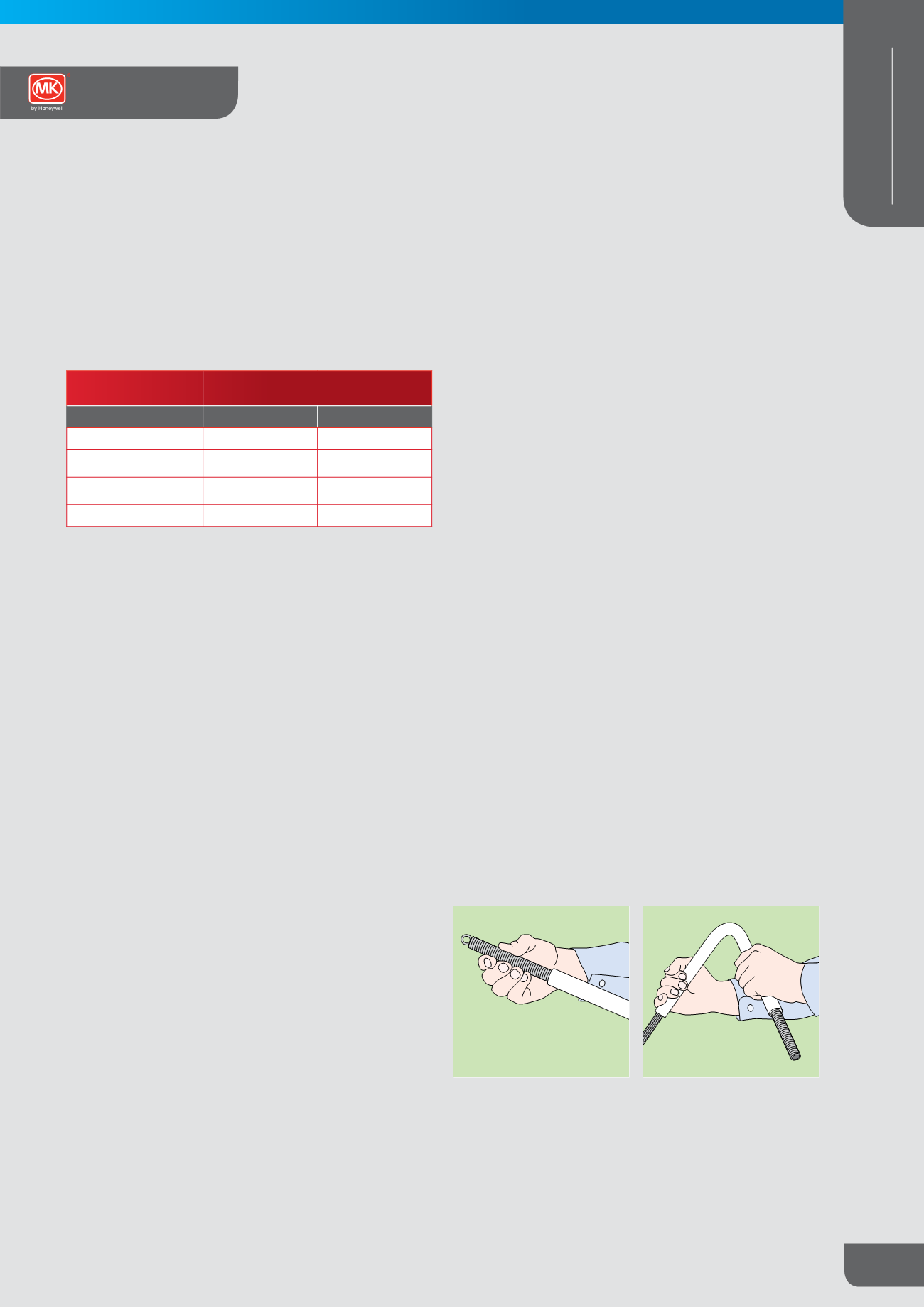
To bend circular conduit, insert the appropriate spring. The
spring has an “eye” formed on one end, to which a cord should
be attached in order to withdraw the spring. The bend is then
made by hand. Twice the angle required should be bent and
the tube then allowed to ease back to the desired position. Do
not attempt to force the bend back with the spring inserted, as
this action will damage the spring. When withdrawing the spring
it is suggested that it be twisted in an anti-clockwise direction
thus reducing the diameter of the spring and providing easy
withdrawal. It is important to use the correct size spring. In cold
weather it may be necessary to warm the tube slightly at the
point where the bend is to be made. Always saddle the tubing as
quickly as possible after bending.