



 149 / 582

BETA Protecting
Residual Current Protective Devices
Residual-current operated circuit breakers
2/41
Siemens ET B1 · 10/2008
2
*
You can order this quantity or a multiple thereof.
Types of current
Due to the use of electronic components in household appliances
and industrial plants, insulation faults can also cause residual
currents that are not AC residual currents to flow through residual
current protective devices, even in the case of devices with
PE/ground terminals (Safety Class I).
The regulations for residual current protective devices contain
additional requirements and test regulations for residual currents
whose power supply frequency is zero or virtually zero within a
certain period.
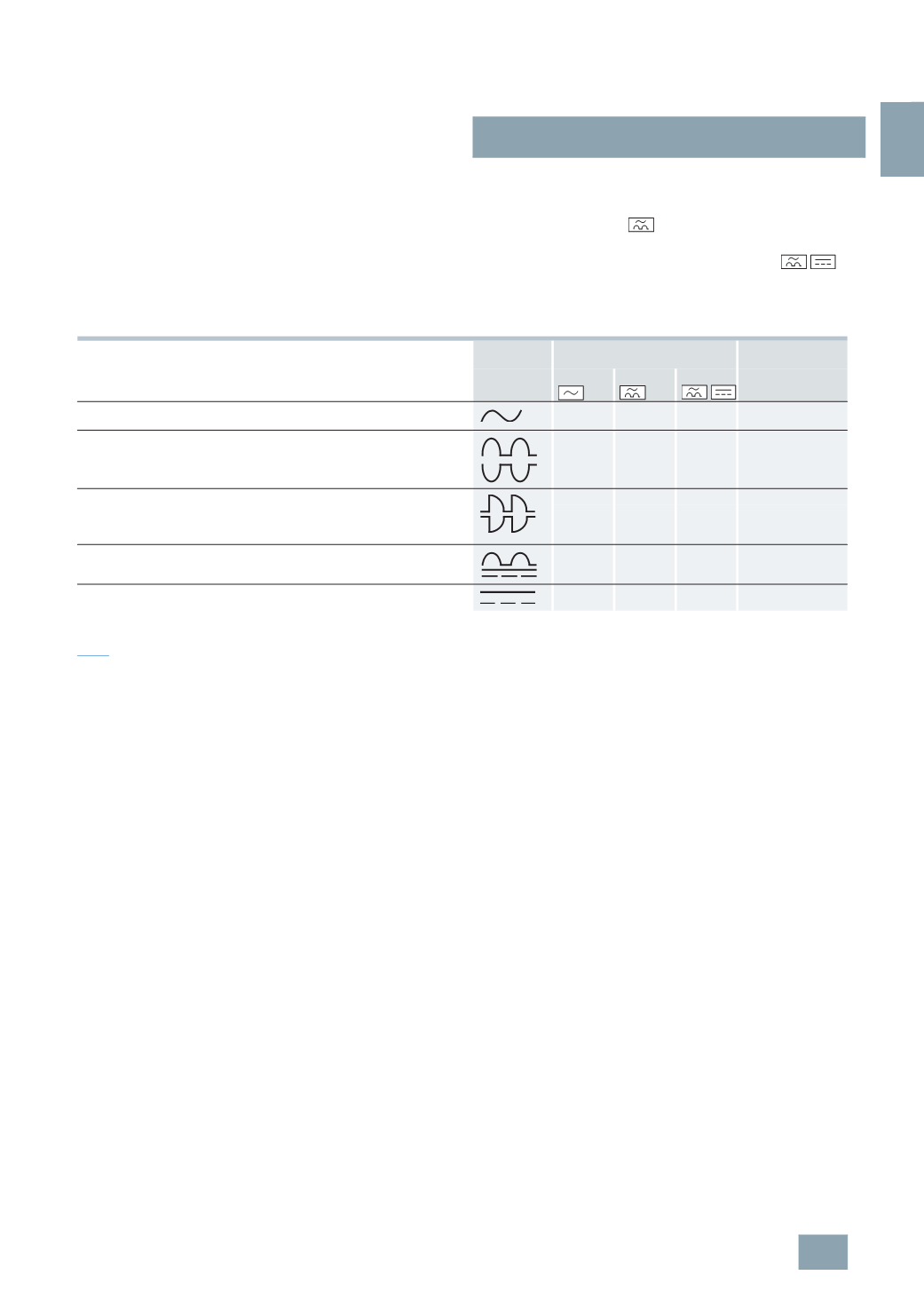
Residual current protective devices that trip for both sinusoidal
AC residual currents and pulsating DC residual currents (type A)
are identified by the mark
.
Residual current protective devices that also trip for smooth DC
residual currents (type B) are identified by the mark
.
1)
Tripping currents according to IEC/EN 61008-1 (VDE 0664, Part -10);
for smooth DC residual currents defined to IEC 60755 UB1 INT.
Note:
You will find further information on the subject of residual current
protective devices in the technology primer "Residual current
protective devices", Order No.: E20001-A5660-P420-V1.
Type of current
Current
waveform
Correct function of residual
current protective devices of type
Tripping current
1)
Type AC Type A Type B
AC residual current
✓
✓
✓
0.5 ... 1.0
I
n
Pulsating DC residual currents (pos. or neg. half-waves)
--
✓
✓
0.35 ... 1.4
I
n
Started half-wave currents
Start angle 90° el
Start angle 135° el
--
✓
✓
✓
✓
0.25 ... 1.4
I
n
0.11 ... 1.4
I
n
Half-wave current during superimposition with smooth direct current of 6 mA
--
✓
✓
Max. 1.4
I
n
+ 6 mA
Smooth direct current
--
--
✓
0.5 ... 2.0
I
n
© Siemens AG 2008