



 144 / 582

BETA Protecting
Residual Current Protective Devices
Residual-current operated circuit breakers
2/36
Siemens ET B1 · 10/2008
2
*
You can order this quantity or a multiple thereof.
■
Overview
Protection over residual current protective devices
In the case of "automatic disconnection of the power supply" by
means of a residual current protective device, it is essential that
the system components and equipment to be protected are fitted
with an appropriately grounded PE conductor. This means that it
is only possible for a person to be subjected to a flow of current
if two faults occur (in addition to an insulation fault, the interruption
of the PE conductor) or in the event of accidental contact with
live parts.
Additional protection (protection against direct contact)
with
I
n
30
mA
Direct contact refers to a situation where a person comes into direct
contact with a part that is live under operating conditions. If a
person directly touches live parts, two series-connected resistors
determine the level of the current – the internal resistance of the
person R
m
and the contact resistance of the location R
st
.
For a proper assessment of the accident risk, it must be assumed
that the contact resistance of the location is virtually zero
The resistance of the human body depends on the current path
and the contact resistance of the skin. Measurements have
shown, for example, that a current path of hand/hand or
hand/foot has a resistance of approx. 1000 .
Based on this assumption, a touch voltage of 230 V would produce
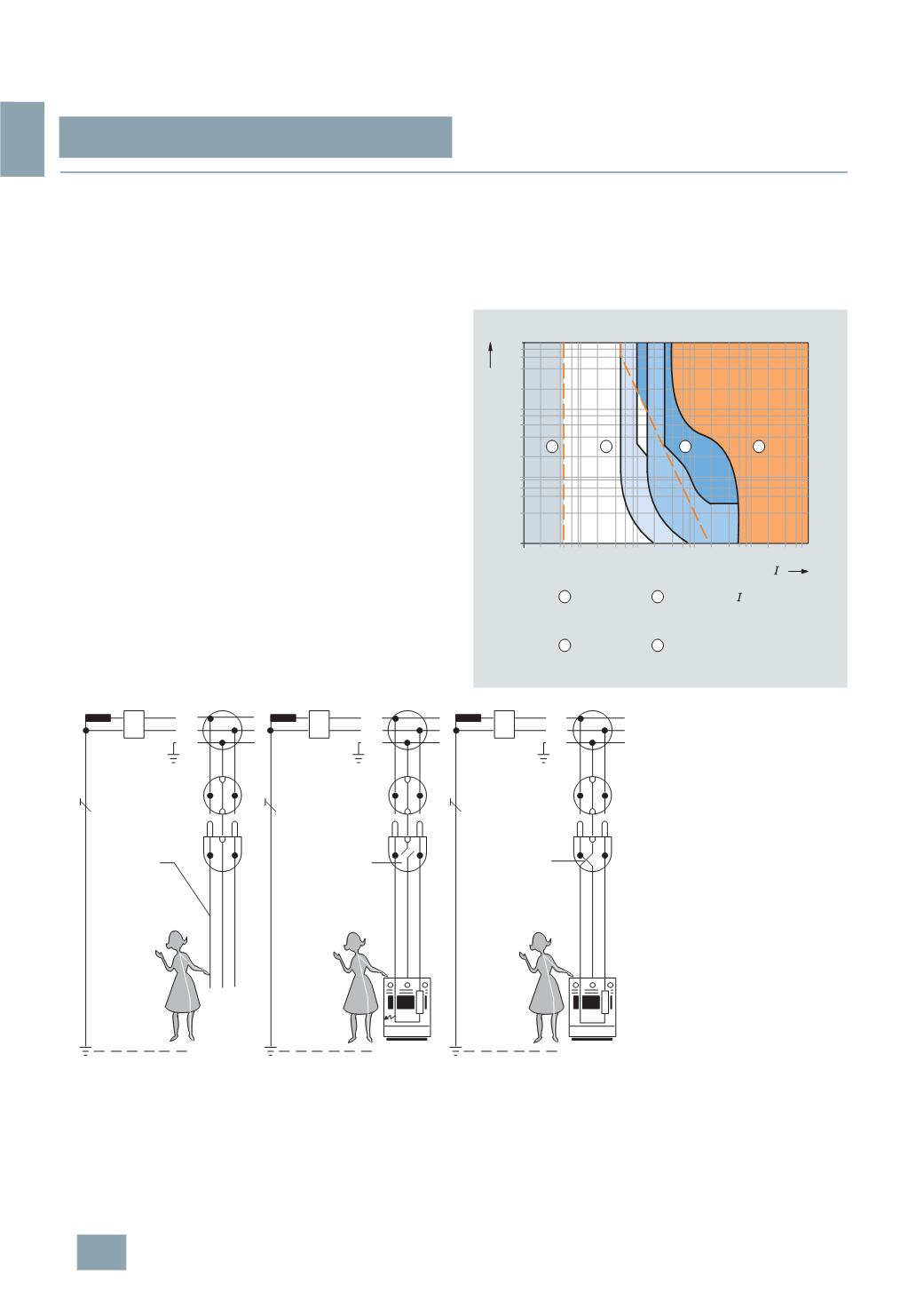
a dangerous leakage current of 230 mA. The illustration "Areas
of impact of alternating current 50/60 Hz on the human body"
shows the current intensity/contact time curve in reference to the
physiological reactions on the human body. The dangerous values
are the current/ contact time values in range 4, as they can trigger
ventricular fibrillations, which can cause death.
It also shows the tripping ranges of the residual current protective
devices with rated residual current 10 mA and 30 mA and the
max. permissible tripping times according to VDE 0664-10. As
can be seen from the tripping curve, residual current protective
devices do not restrict the level of the fault current, rather they
have a protective effect due to the fast disconnection of the current,
and thus short contact time.
Residual current protective devices with rated residual current
I
n
10
mA have a tripping characteristic in range 2, i.e. below
the let-go current. There are generally no injurious effects or
muscle spasms (see illustration). They are therefore suitable for
sensitive areas, such as bathrooms.
I2_13979
t
M
M
10000
1000
100
10
ms
0,1
1
10
100
1000
mA
10000
1
30
mA
2
3
4
10
mA
t
1
2
Range :
Usually
not perceptible
Range :
No muscle
spasms
Areas of impact of alternating current 50/60 Hz on the human body
3
4
Range :
Muscle spasms
possible
Range :
Ventricular fibrillations
may occur
:
Leakage
current
:
Contact
time
!
"
!
#
$
%
$
!
&
&
&
Examples of accidental direct contact
© Siemens AG 2008