



 6 / 52

6
There are a variety of ways in which back-
up power can be provided. However, even
though certain methods are suitable for critical
applications, they may not necessarily be
suitable for Emergency Lighting.
This is because an Emergency Lighting system has
unique load characteristics. And since Emergency
Lighting is a critical life-safety installation it is vital
that a Central Power Supply System provided to power
it is designed with these load characteristics in mind.
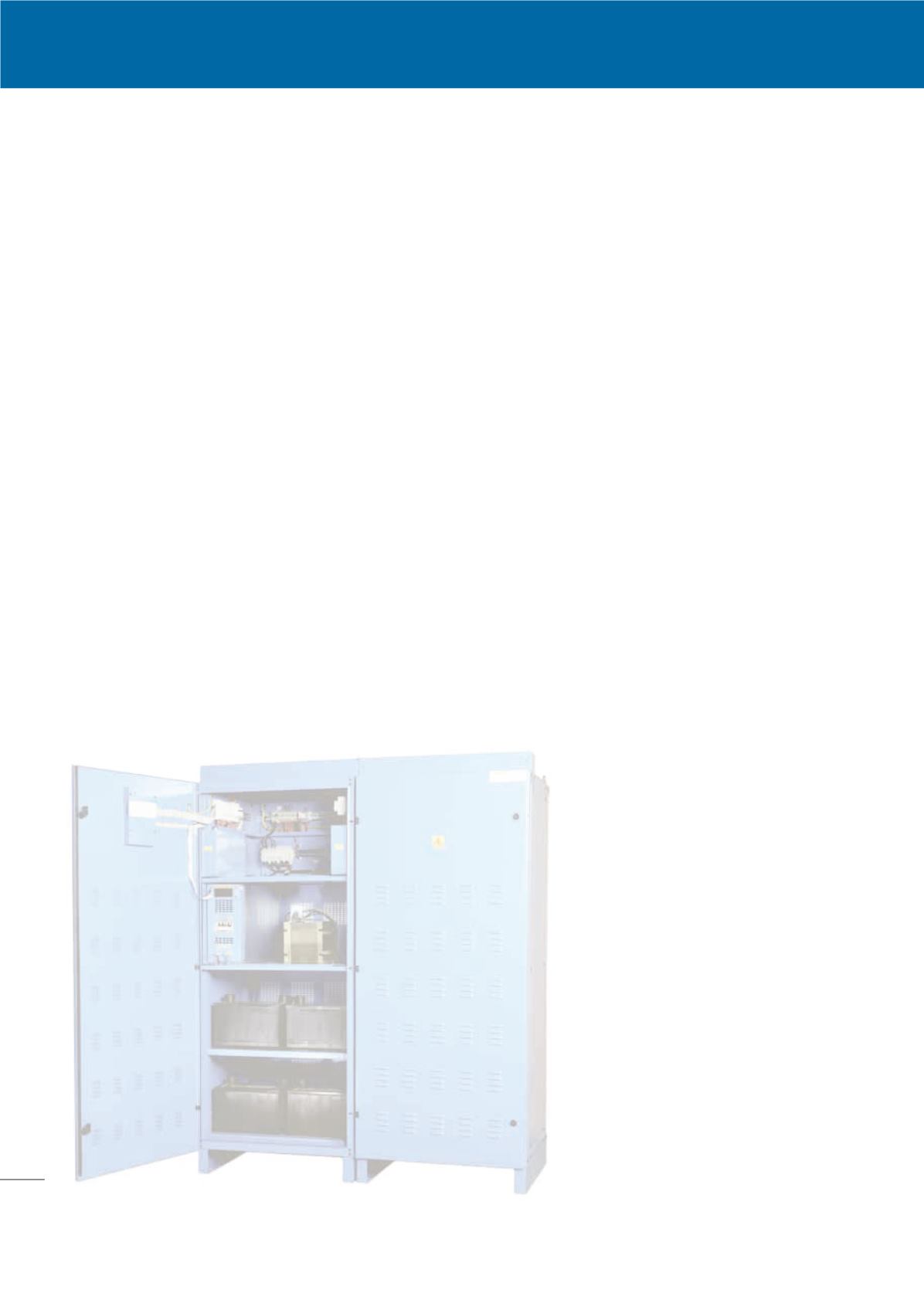
EMEX Power central inverter systems are specifically
designed to provide emergency power for lighting
systems in a mains fail or evacuation situation.
In choosing the right AC system to support emergency
lighting it is important to consider the following
questions:
Overload performance
BS EN 50171 requires that an inverter must be able to
start the full load without the mains supply present.
How does the system perform in a total power failure
(ie is the system able to start the load without the
bypass supply being available)?
Repeat duty
BS EN 50171 requires a Central Power Supply System
to fully recharge within 24 hours. Is the charger able
to recharge the batteries sufficiently quickly (80% in
12 hours or 100% after 24 hours)?
Energy consumption and heat
dissipation
Is the inverter and charger permanently running,
reducing the battery life, generating heat and
wasting energy?
Are cooling fans running continuously, generating
noise and reducing component life?
Maintenance
Is the system easy to service and maintain? Is the
system designed in a modular format, or would the
failure of even a minor component require the whole
system to be shut down and stripped for repair?
General information on
Uninterruptible Power Supply (UPS)
systems, for guidance:
Recharge period
UPS systems which are designed primarily for
computer back-up generally offer short back-up times,
and consequentially employ small chargers. To provide
the longer durations specified for emergency lighting,
a much larger capacity battery is fitted. However, if
the charger is not uprated then the system will not be
capable of recharging sufficiently quickly. Hence the
battery rating is sometimes increased even further so
that it is not fully discharged at the end of the rated
duration period (and is thus capable of “repeat duty”
with limited further recharge). This results in a much
larger system that is actually required for the load,
increasing both the physical space required and future
battery replacement costs.
Overload and short circuit
performance
An emergency lighting load imposes large ‘in-rush’
currents when starting lamps from cold. However, UPS
systems are often designed to shut down at only 125%
overload and revert to the incoming supply. During a
total power failure situation, this could result in total
failure of the emergency lighting system. Furthermore,
a UPS may fail to clear a protective device on a
lighting circuit, meaning that a single short circuit
fault could result in loss of the entire emergency
lighting provision.
Energy consumption and battery life
Most UPS systems operate in the ‘on-line’ mode,
whereby the inverter runs constantly to supply the
load, and power is taken from the battery with the
charger running constantly. This places an excessive
ripple on the battery (in contravention of the advice
given by most battery manufacturers). Also, the system
is constantly generating heat which has a further
detrimental effect on battery life. There are energy
cost implications to run an on-line system, and deal
with the heat generated.
Neutral isolation
Some UPS systems use the incoming neutral conductor
as the output neutral, with no isolation. Quite
apart from that fact that this does not comply with
electricity supply regulations, should the input neutral
be lost in some way (for example if it were broken
due to a fire or other physical damage to the building)
then the output neutral would also be lost, resulting
in the failure of the entire emergency lighting
provision.
Choosing the right system
www.emergi-lite.co.ukIntroduction