



 5 / 52

5
www.emergi-lite.co.ukIntroduction
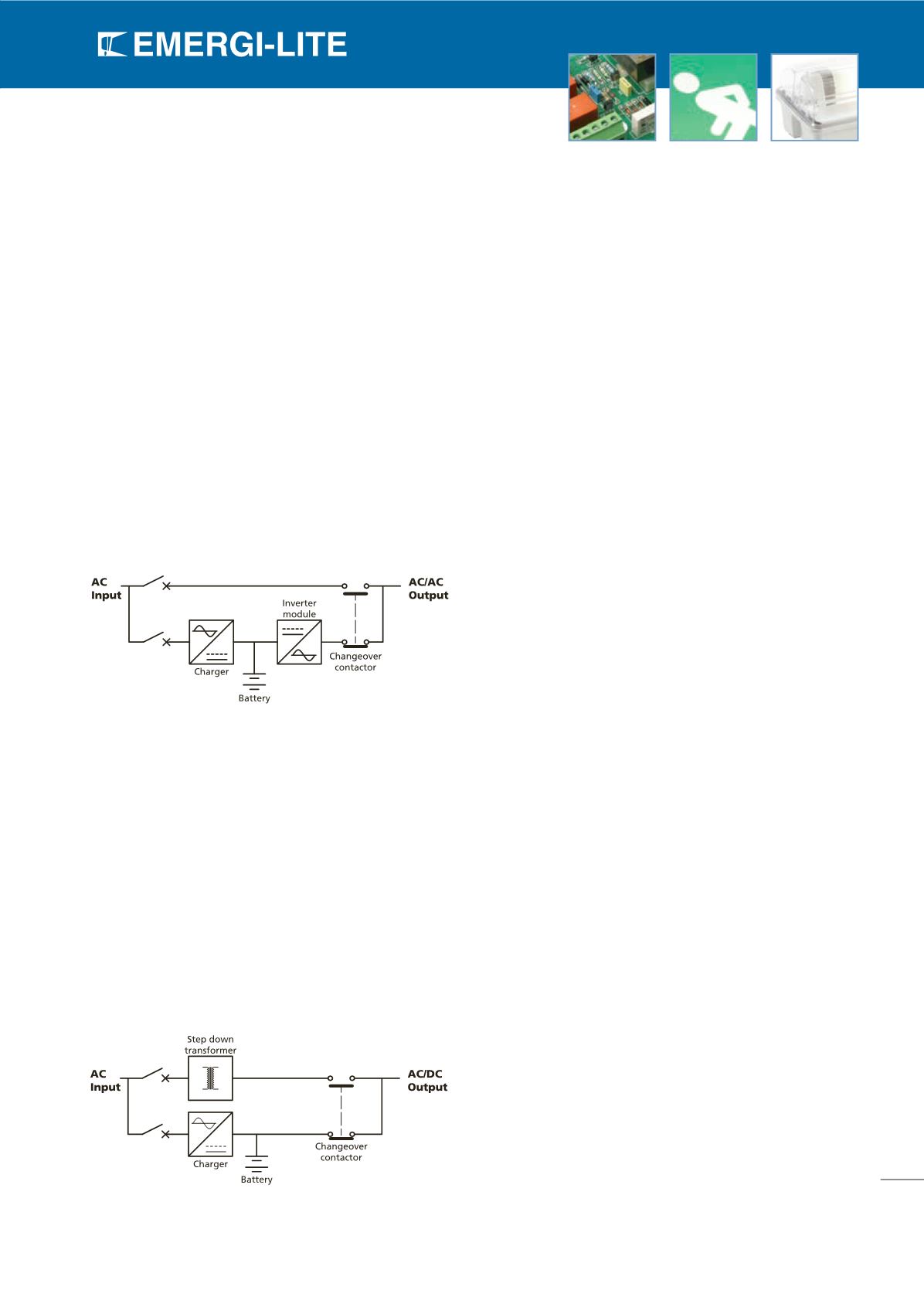
Static Inverter Systems (AC/AC)
Static inverter systems operate in a similar manner
to AC/DC Central Power Supply Systems, with the
exception that the system constantly gives a 230V
AC output. The advantages of this approach are
numerous. Firstly, luminaires do not need to be
converted, as any slave 230V luminaire can be used
(there are some restrictions to this on the grounds
of suitability for emergency lighting). Luminaires
also operate at full light output, as they are being
fed from a full mains voltage supply, meaning fewer
luminaires are required for equivalent light outputs.
Central Power Supply Systems
(AC/DC)
Central Power Supply Systems provide low voltage
AC power (nominally 24V, 50V or 110V AC) whilst
mains to the system is healthy, and low voltage DC
(of the same voltage) when mains fails. The battery
voltage selected will depend upon the number of
luminaires, the rating, their type and their distance
from the central system. Central Power Supply Systems
require each emergency luminaire to be converted
for use on the low voltage supply. The cost of this
conversion may be prohibitive on larger installations.
Another important factor is that converted luminaires
only provide a small percentage of their normal light
output when running in emergency mode.
Central systems fall into two categories – AC/AC static inverter systems and AC/DC power supply systems. Both types
of central system operate on the same principle; that the luminaire is fed, via emergency sub-distribution, from a
single supply source (the central system). The term ‘static inverter’ is derived from the lack of moving parts within
the equipment, as opposed to rotary motor/generator converter designs.
Central systems allow a wide range of batteries to be used, which offer different life expectancies against physical
size and cost, localised battery/equipment maintenance, flexible lighting design and greater light output per
luminaire.
Advantages
l
Suitable for medium to large installations
l
Almost any luminaire may be used
l
Easy to maintain
l
10 to 25 year design life batteries
l
Distribution is standard 230V AC (standard DBs)
l
Reduced volt-drop problems on output cabling
l
Luminaires operate at full light output which
makes inverter systems suitable for high risk
task area lighting and installations where ceiling
heights make low output luminaires unusable
Disadvantages
l
Not cost effective for small installations
l
Larger systems are physically large and may
require special battery room
Advantages
l
Reduced cost for smaller installations
l
Small physical size
l
Easy to maintain
l
5 to 25 year design life batteries
Disadvantages
l
Not cost effective for large numbers of luminaires
l
Cable restrictions to avoid volt-drop
l
Luminaires must be converted for use on AC/DC
l
Reduced light output in emergency mode