



 3 / 52

3
www.emergi-lite.co.ukIntroduction
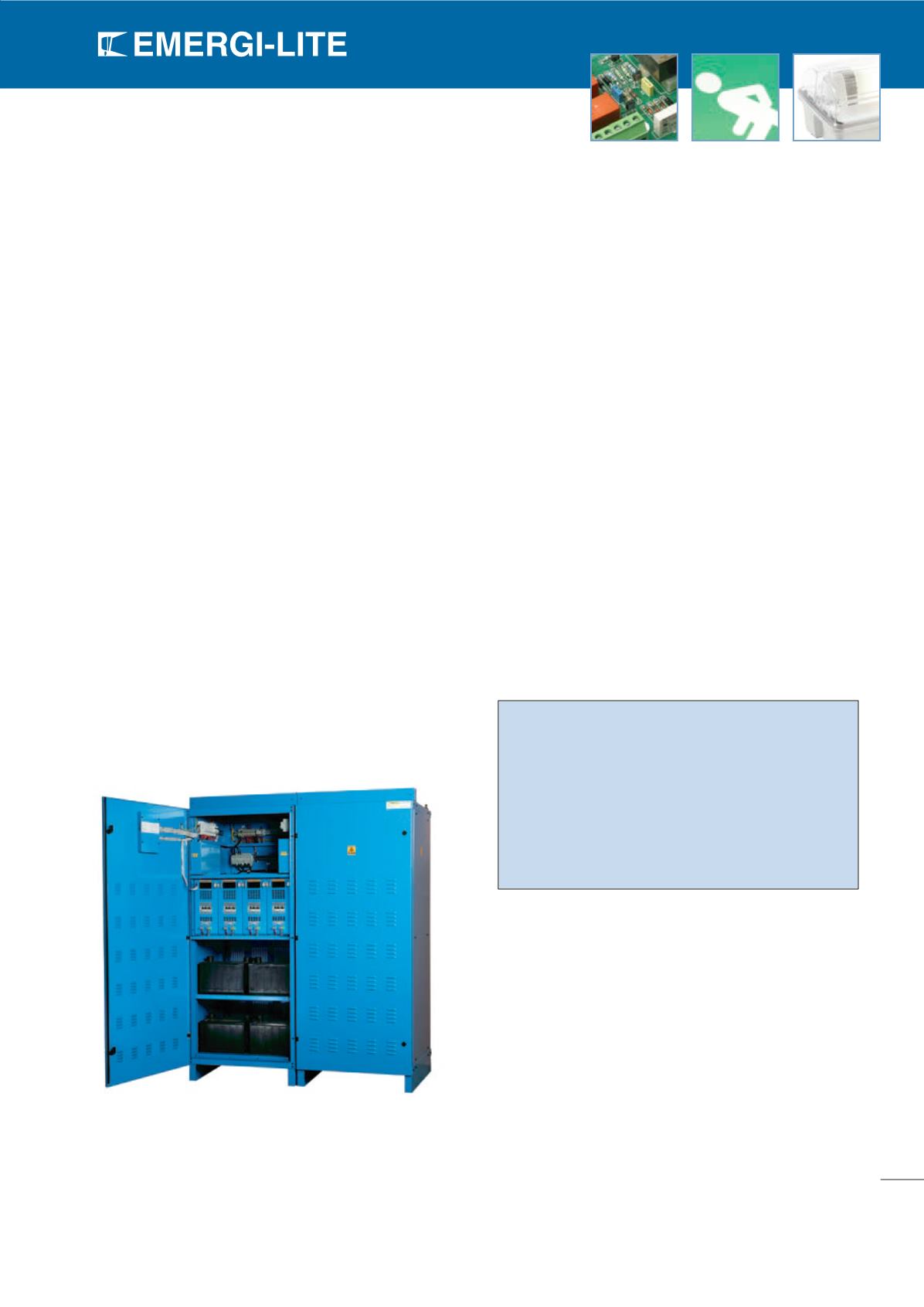
A Central Power Supply System (CPS) is
essentially a large set of batteries at a single
central location. In the event of a mains failure
in the building, the batteries are used to provide
power for emergency lighting purposes.
The CPS comprises the battery set, battery charger,
control circuitry, alarms and instrumentation to ensure
reliable provision of emergency power when required.
The CPS output will typically be 24V, 50V, 110V, or
220/230/240/380/400V, according to type.
Output is usually AC/DC for the lower voltages,
and AC when mains voltage.
The CPS will be sized according to the load required.
The battery will be rated to achieve a specified
duration, typically 1, 2, or 3 hours.
A larger project may use one single large CPS,
or a number of smaller CPS units.
Who decides?
The voltage of the CPS is influenced by the size
and nature of the project. The final decision
may be taken by the consultant, end user, or
contractor.
The duration or autonomy of the CPS is often
dictated by national Standards (eg BS 5266), or
local authority requirements.
What is a Central Power Supply System?
How does it work?
The CPS effectively stores energy in the battery set
whilst the mains supply is healthy, and draws upon
this reserve when required in times of mains failure.
If the failure is limited to part of the building (local),
the CPS may provide power using its incoming supply
without discharging the battery.
Mains failures are detected by sub-circuit monitoring
relays to ensure the automatic, fail-safe operation of
the emergency lighting. These are situated around
the building where required, or may be located within
the CPS itself.
Power from the CPS is distributed to dedicated
emergency luminaires and exit signs, or converted
slave 230V luminaires. Standard, unmodified slave
230V luminaires can be used on a mains-voltage CPS.
Distribution cables need to be fire protected,
according to local regulations and/or risk assessment.
What are its benefits?
A CPS system gives a higher light output per point
when compared to a self-contained installation, and
therefore will use fewer emergency lights per area.
A CPS solution offers great savings in ongoing testing,
maintenance, and replacement battery costs when
compared to a self-contained emergency lighting
installation.