



 55 / 100

PowerSafe – Commercial & Industrial
55
Protecting electrical installations
against transient overvoltages
using SPDs
British Standard BS EN 62305:2011 Protection against
lightning and the IET Wiring Regulations 17th Edition, BS
7671:2008 (+A1:2011) define requirements for selection and
installation of SPDs to protect against transient overvoltage
risk.
SPDs are recommended as follows, according to the
installation:
s ,IGHTNING CURRENT EQUIPOTENTIAL BONDING 30$S 4YPE
or Combined Type 1+2) to protect against flashover –
required on incoming/outgoing metallic service lines
which have ‘live cores’ if a building includes an external
LPS or overhead service lines at risk from a direct
lightning strike
s 4RANSIENT OVERVOLTAGE 30$S 4YPE 4YPE OR #OMBINED
Type 2+3) to protect against transient overvoltages
caused by indirect lightning strikes and switching events
For either Type, the function of the SPD is to limit transient
overvoltages to a safe level by diverting excess energy either
to earth or away from the sensitive and critical electrical
equipment (see Figure 4).
Transient
overvoltage
SPD
Surge
(close)
Normal
(open)
Equipment
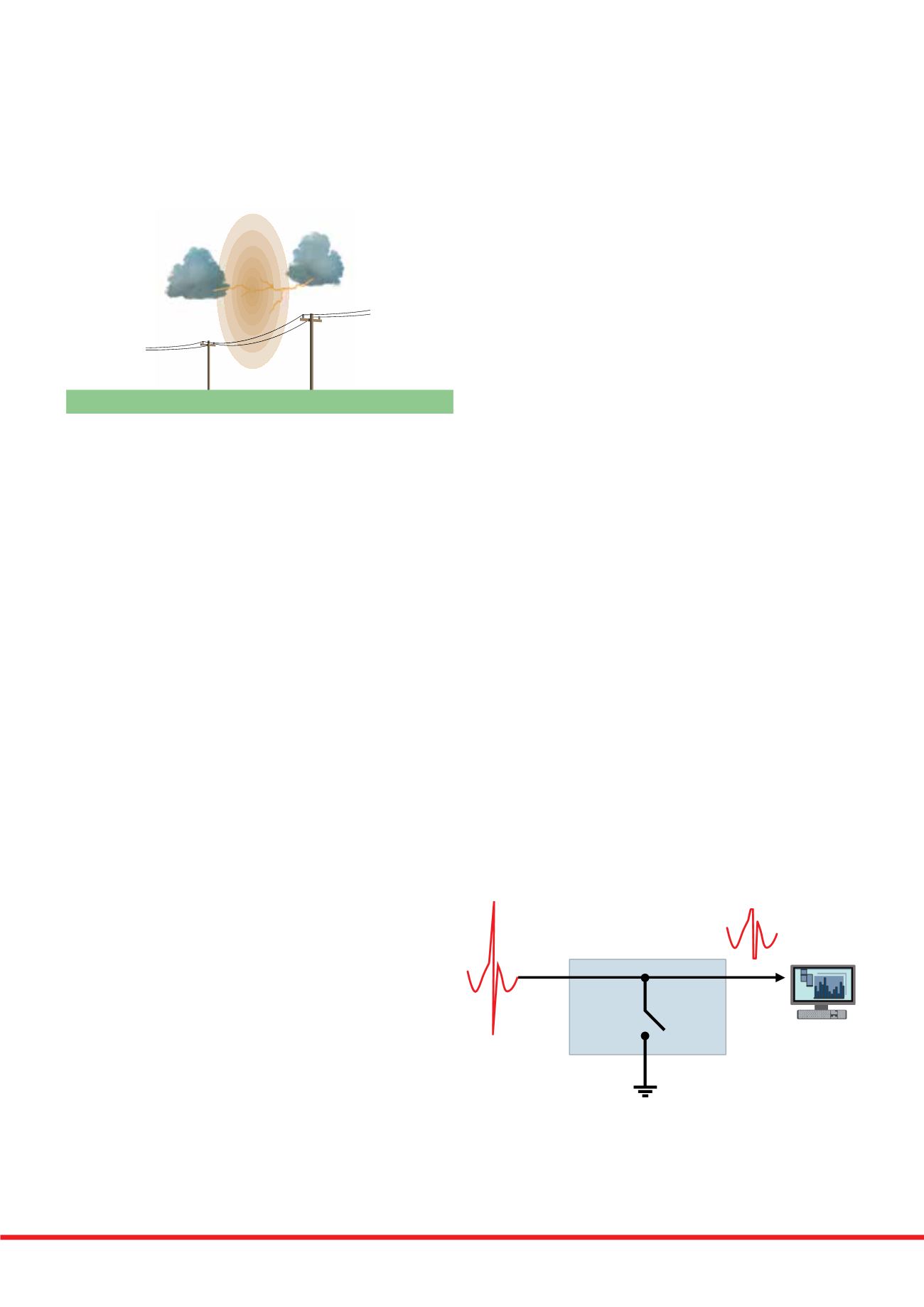
Figure 3: Inductive coupling
Lightning discharges give rise to an electromagnetic field. If metallic
service lines pass through this electromagnetic field a voltage will be picked
up by, or induced onto, the lines.
Transient overvoltages can therefore enter a structure via these
connected metallic services, and damage electronic systems as the
overvoltage attempts to flow to earth.
BS 7671 and BS EN 62305 make clear however that
installation of lightning current/equipotential bonding SPDs
alone provides no effective protection against failure of
sensitive and critical electronic systems.
Transient overvoltage SPDs should be installed downstream
at sub-distribution boards and at critical electrical equipment
to ensure effective protection.
BS 7671 gives guidance, through Sections 443 & 534, on
transient overvoltage protection of AC power supplies to
ensure satisfactory electrical installation, which includes:
s 30$ INSTALLATION AS CLOSE AS PRACTICABLE TO THE ORIGIN
of the supply, generally in the main distribution board,
after the meter – to counter incoming high level transient
overvoltages at the service entrance
s 30$ INSTALLATION AS CLOSE AS PRACTICABLE TO TERMINAL
equipment (sub-distribution level or local to critical
equipment) – to cover risk from voltage oscillations within
the electrical system
s 3HORT CONNECTING LEADS IDEALLY LESS THAN M BETWEEN
the SPD and the conductor – to reduce risk of additive
inductive voltages after the SPD
s 30$ COORDINATION THROUGHOUT THE INSTALLATION
The Havells PowerSafe solution with Furse
®
SPD kit has
been specifically designed to achieve all these requirements.
Furse
®
SPD kits are available for all Havells PowerSafe main
distribution and sub-distribution boards, and are supplied
with a standard cable loom, to ensure the shortest possible
lead length between the SPD and distribution board.