


 150 / 430

4.28
General Catalogue • Protection Devices
Surge Protection
Risks of Electrical Surges
Surge protective devices (SPD)
assist in the protection of
valuable electrical and electronic
equipment against transients,
originating from lightning and
also from switching sources.
These transients can cause
damage ranging from the
premature ageing of equipment,
logic failures and down time,
to the complete destruction
of equipment within the entire
electrical installation. Products
such as LCD screens, data
servers and industrial equipment
such PLC’s are critical to
business activity. Protecting
this equipment may now be a
necessity.
The Hager SPD range of
solutions may offer protection
to prevent damage to this
sensitive equipment by diverting
the damaging transient over-
voltages. In the majority of cases
this will eliminate equipment
failures and reduce downtime.
The choice of a surge protective
device depends upon:
• The exposure of the building
to lightning transients
• The sensitivity and value of
the equipment that requires
protection (it is recommended
that the contractor should
discuss the installations
requirements with the customer)
• The location and therefore
the exposure level of the
installation
• The equipment used within
the installation and whether this
equipment could generate
switching transients
BS 7671 and the AQ criteria
method
Lightning discharges could
contain currents of 200,000A
which if struck at or near
power transmission lines
would generate a significant
voltage transient. This voltage
transient could cause significant
damage to both domestic
and commercial electronic
equipment.
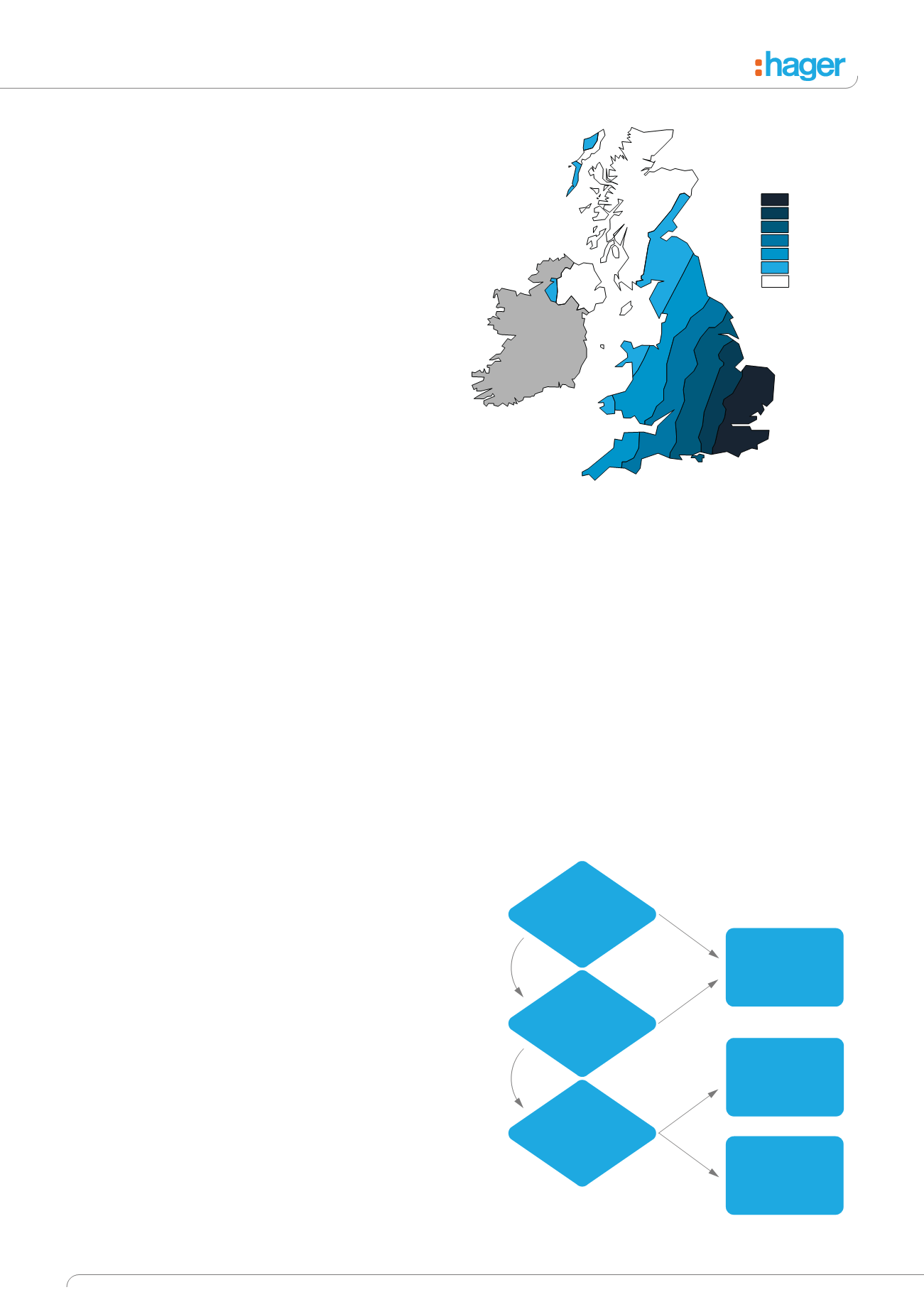
The UK regional map illustrates
the likely lightning activity
caused by the number of
thunderstorm days across the
country.
Protection against over-voltages
is the subject of section 443 of
BS 7671. Here the AQ criteria
method is introduced which is
based on the likelihood of the
equipment being subjected
to over-voltages caused by
lightning strikes, taking account
of the probable number of
lightning strikes per year.
For electrical installations
in the UK, the map shows
that the probable number of
thunderstorm days per year in
any given location is less than
25, and therefore condition AQ1
applies.
Where this is the case and for
installations being supplied
by overhead lines, Regulation
443.2.2 indicates that provided
the impulse withstand voltage of
the equipment is not less than
the values given in Table 44.3
(see Table 1 for installations
rated at 230 V to Earth), no
additional protection by a SPD is
required. However, where higher
levels of equipment reliability
or higher risks (e.g. fire) are
expected, additional protection
by an SPD against over-voltage
may be required.
Similarly, for an installation
having overhead lines, no
additional protection against
overvoltages is required if the
equipment meets the minimum
voltage withstand values in table
44.3.
There are some words of caution
in the notes to this section where
it is recognised that transient
over-voltages transmitted by
the supply distribution system
are not significantly attenuated.
So an induced voltage some
distance away could easily
manifest itself at the electrical
installation and cause potential
harm to the equipment within.
It is also worth considering that
the AQ data is for thunderstorm
days NOT lightning strikes. One
storm will usually contain many
lightning flashes which could
lead to an over-voltage on the
installation causing damage to
equipment.
Cascading
Cascading is the term used
to describe the method of
combining several levels of surge
protection devices into the one
installation.
This takes advantage of the
best features of each device
to improve the protection
level for the equipment. Hager
recommends using a high surge
current capacity device to
divert the bulk of the transient
over-voltage at the origin of the
installation.
In the case of a Class 1 & 2
device this would be either the
spark gap arrester or a high
current capacity MOV. Should
finer protection be required, the
next step is to install a Class 3
device SP202N near the terminal
equipment.
Cascading increases the current
diverting capacity of the SPD
system whilst maintaining a
low voltage (Up) to ensure the
best protection for valuable
equipment.
Selecting SPD of the same
manufacturer or make will ensure
correct co-ordination between
devices.
SPD Quick Selection Guide
The following is a quick selection
guide which may assist
in choosing whether SPD’s are
required and the correct
type of device
• Does the installation contain
a lightning protection system?
• Is the installation adjacent to
any tall structure, tall trees or
near a hill top in a lightning prone
area?
• Does the installation contain
equipment where higher
reliability from overvoltages is
required
If the answer is YES in the above
to the first two questions, it is
recommended to install a Type
1+2 device. This will provide
protection against surges caused
by direct lightning strikes and
provide protection against
transient over-voltages caused
by indirect lightning strikes or by
switching events.
If the answer is YES to the third
question then it is recommended
to install Type 2 devices to
provide protection against
transient over-voltages caused
by indirect lightning strikes or by
switching events.
!
!
!
0DSFRXUWHV\RIWKH0HW2IĺFH
)2* .& $)1%#3 +)'(3-)-'
2%%
.1
+)'(3-)-' /1.3%#3).-
2723%, )-23!++%$
5%1(%!$ +)-%
24//+7)-' 3(% "4)+$)-'
!3 1)2* .& $)1%#3 231)*%
2%%
-23!++!3).- /1%2%-32
KLJKHU ULVN H J ĺUH RU
1%04)1%2 ()'(%1 1%+)!")+)37 &1.,
.5%15.+3!'%2 )-#+4$)-' 26)3#()-'
.3% 2%%
.
%2
%2
%2
.
.
5%15.+3!'% /1.3%#3).-
1%04)1%$ -23!++ 7/% .1 7/%
2 !3 $)231)"43).-
".!1$ #.-24,%1 4-)3 3.
SUHYHQW GDQJHURXV ĻDVKRYHU
. .1$)-!3%$ 2%3 .&
.5%15.+3!'% 2 &.1
%04)/,%-3 /1.3%#3).- % '
7/% .1 7/% &.1
$)231)"43).- ".!1$2 &%%$)-'
2%-2)3)5% %+%#31.-)# %04)/,%-3
1.3%#3).- !'!)-23 .5%15.+3!'%
)2 -.3 1%04)1%$
)& %04)/,%-3 ),/4+2%
6)3(23!-$ 5.+3!'% 3. !"+%
63' GHFLVLRQ ĻRZ FKDUW IRU LQVWDOODWLRQV
6)3()- 3(% 2#./% .& 3()2 '4)$%
.1 +!1'%1 )-23!++!3).-2 "%7.-$ 3(% 2#./% .& 3()2 '4)$% ! 1)2* !22%22,%-3 ,%3(.$
42%$ 3. %5!+4!3% 3(% -%%$ &.1
2 )2 ')5%- )- %#3).- .&