



 238 / 272

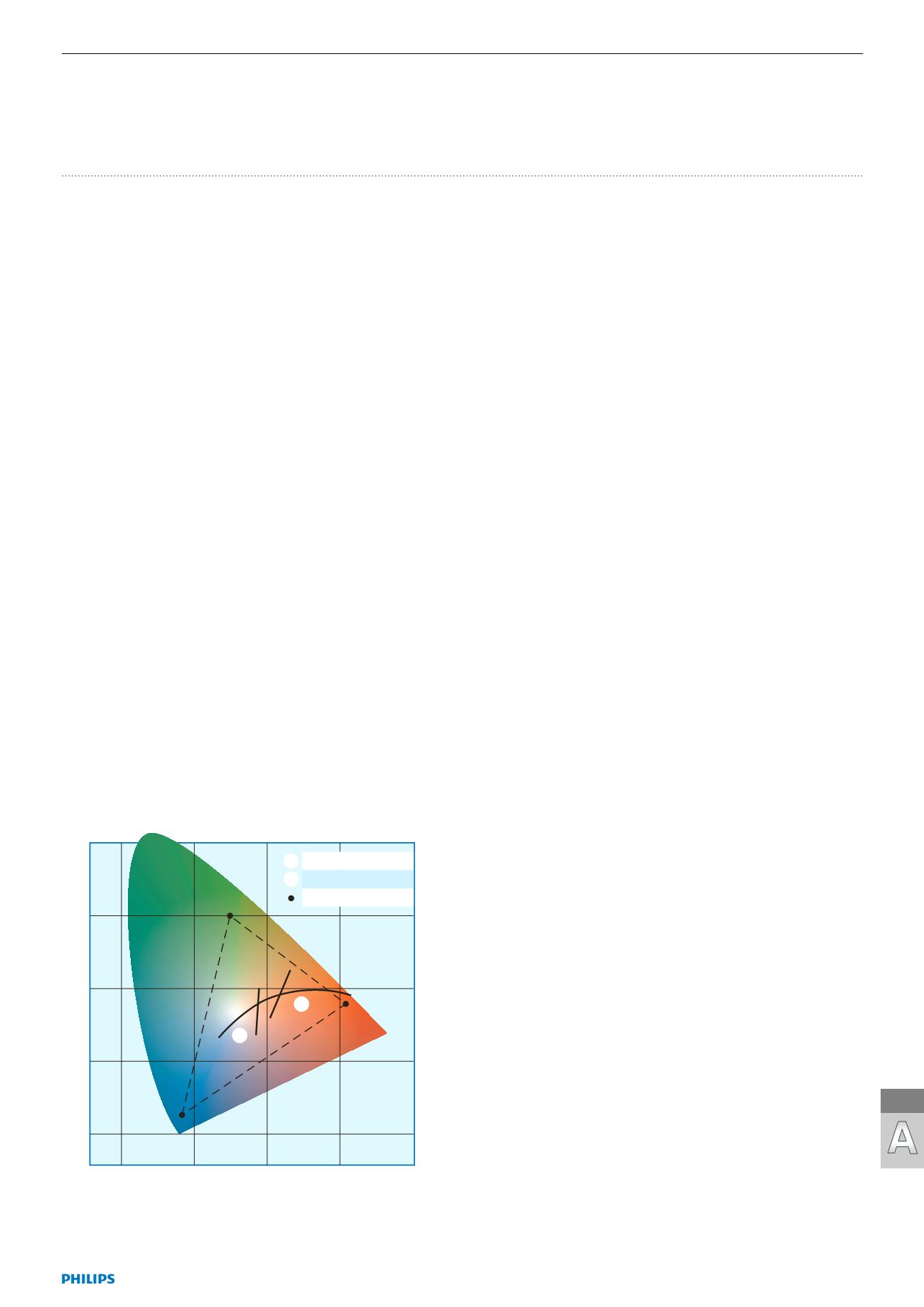
10. Object colours, chromaticity diagram, light colour
The perception of colour is caused by visible radiation
stimulating the receptive system of the eye. The colour
stimulus originates either directly from a light source
or an object being illuminated or shone through. Object
colours are generated by illumination and depend on the
respective light’s spectrum as well as the object’s degree
of spectral relectance. The chromaticity diagram enables
the exact determination of each colour utilizing the two
colour value coordinates x and y. The diagramwas deined
by the international lighting commission in 1931. To this end
a graph representing the spectrum from 380 nm (violet) to
520 nm (green) and 780 nm (red) was placed in a cross-plot
containing x- and y-coordinates. This spectrum locus is being
closed by the purple boundary. The chromaticity diagram
includes all real colours. Achromatic in the colourimetric
sense is situated at the centre of the chromaticity diagram
with the chromaticity coordinates x = y = 0.333. The graph in
the chromaticity diagram contains the temperature values
in Kelvin of a black body being heated to the respective
temperature (Planck’s radiation). The light colours of the
various light sources are described by the x- and y-values. The
temperature values (colour temperature) designate the light
colour of a light source. A light source outside the Planckian
locus is described by the most similar colour temperature with
the aid of an auxiliary diagram containing lines transverse to
the Planckian locus ( Judd lines).
510
520 nm
560
580
600
780
500
480
380
490
540 nm
Green
Blue
Red
3300K
5000K
tw
nw
ww
0
0,2
0,4
0,4
0,2
0
0,6
0,6
0,8
y
Daylight
D
D
P
P
Black body
Luminous matter Super 80
X
Chromaticity Diagram
Appendix>
Lighting Technology
Philips Lamps and Lighting Electronic Catalogue 2014
238
13