



 237 / 272

6. Black body
The black body is an ideal thermal radiator which absorbs
all occurring radiation. It neither transmits nor relects
radiation. Its radiation characteristics are known in detail
and can be precisely calculated for all wavelengths and
temperatures. The major part of the radiation is emitted in
the infrared range. The radiance increases considerably with
rising temperatures, causing a shift of the maximum
to the shorter wavelengths. Eicient light generation
with thermal radiators therefore requires the highest
possible temperatures, using materials with high fusion
temperatures.
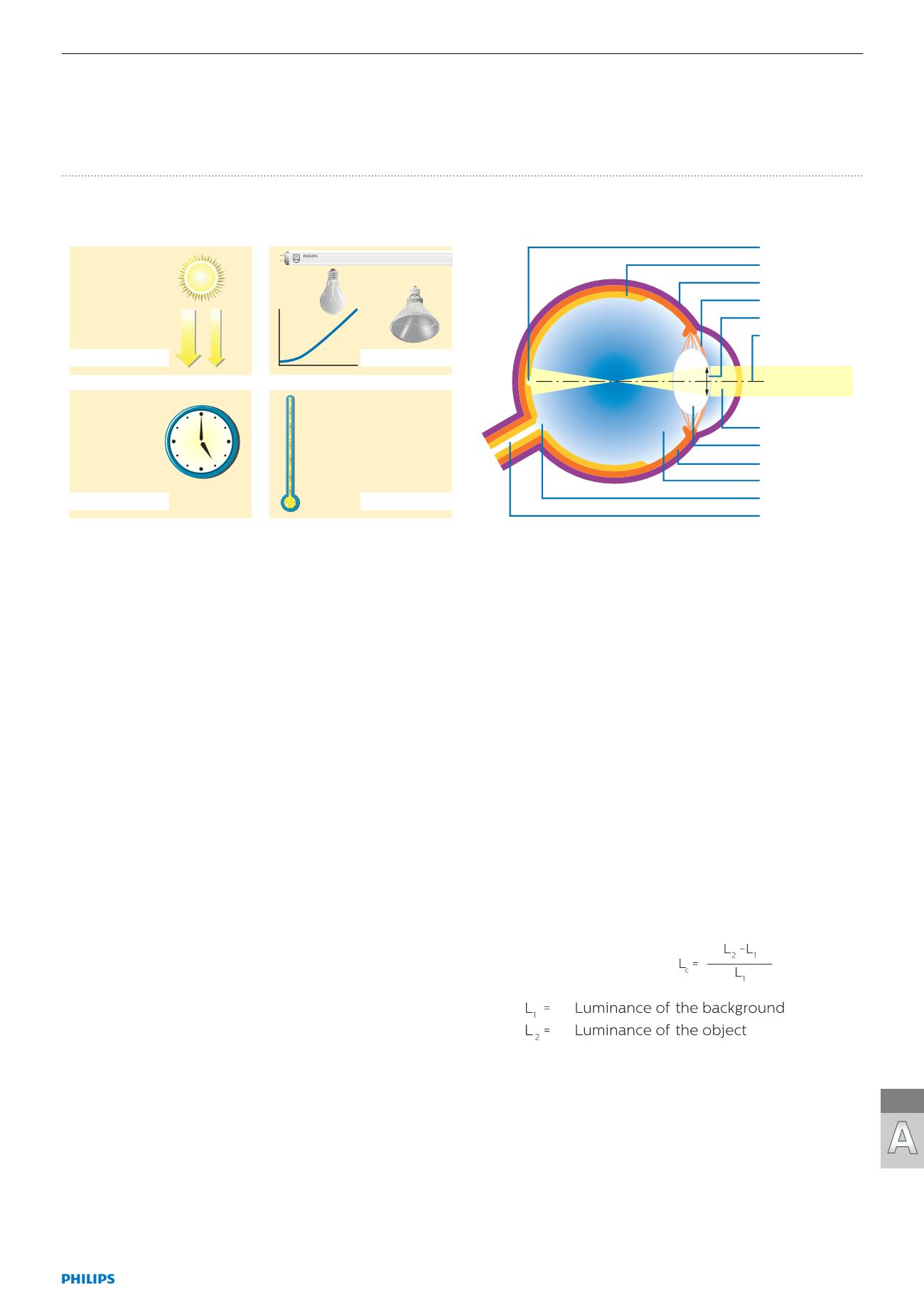
7. The eye
The clear transparent cornea accounts for the major part of
the eye’s refractive power, making it possible to create an
image of the perceived object on the retina. The anterior
chamber of the eye gives the lens the required room for
accommodation. The iris functions as aperture and the
pupil restricts the light incidence. The retina contains
the receptors for the light stimulus. These are on the one
hand 130 million rods enabling vision even in twilight and at
night without colour perception though. On the other hand,
the 7 million cones of the retina enable vision in daylight
and the perception of colours. The lens’ radius of curvature
is variable and can thus adapt the eye to the respective
distance of vision. At the spot where the nerve cord exits
the eye the retina contains neither rods nor cones, it is
therefore also called blind spot. At the level of the optical
axis there is a high concentration of cones. This designates
the area of sharp vision, called fovea centralis.
8. Adaptation
The eye’s ability to adjust itself to varying luminances
by modifying the pupil’s aperture is called adaptation,
enabling a constant visual power over a wide range
of illuminances. The time sequence of the adaptation
depends primarily on the luminance at the beginning and
end of the adaptation. If the illuminance changes from light
to dark (dark adaptation) the duration of the adaptation
is very long (over 30 min.). Light adaptation (from dark to
light) is much quicker.
9. Contrast and contrast sensitivity
Objects can be distinguished primarily on the basis of the
diference in luminance and colour between the object
and its immediate surroundings. Subjective contrast is
the evaluation of the diference between two directly
consecutive impressions. The objective deinition of the
luminance contrast Lc is expressed in the following equation:
The contrast sensitivity expresses the least possible
luminance contrast the eye can discern. Contrast sensitivity
is inluenced by the luminance, the adaptation of the eye
and other ambient conditions such as glare from light
sources in the visual ield.
Time
Illuminance
Spectrum
Temperature
C
TL-K
Fading and Discoloration
of materials through light
Iris
Pupil
Eye axis
Anterior chamber
of the eye
Lens
Choroidea
Vitreous body
Blind spot
Nerve cord
Fovea centralis
Retina
Cornea
The Eye — A Camera
Appendix>
Lighting Technology
Philips Lamps and Lighting Electronic Catalogue 2014
237
13