




 401 / 413

9/13
Topologies
Technical information
Ethernet network
Infrastructure
Different network topologies
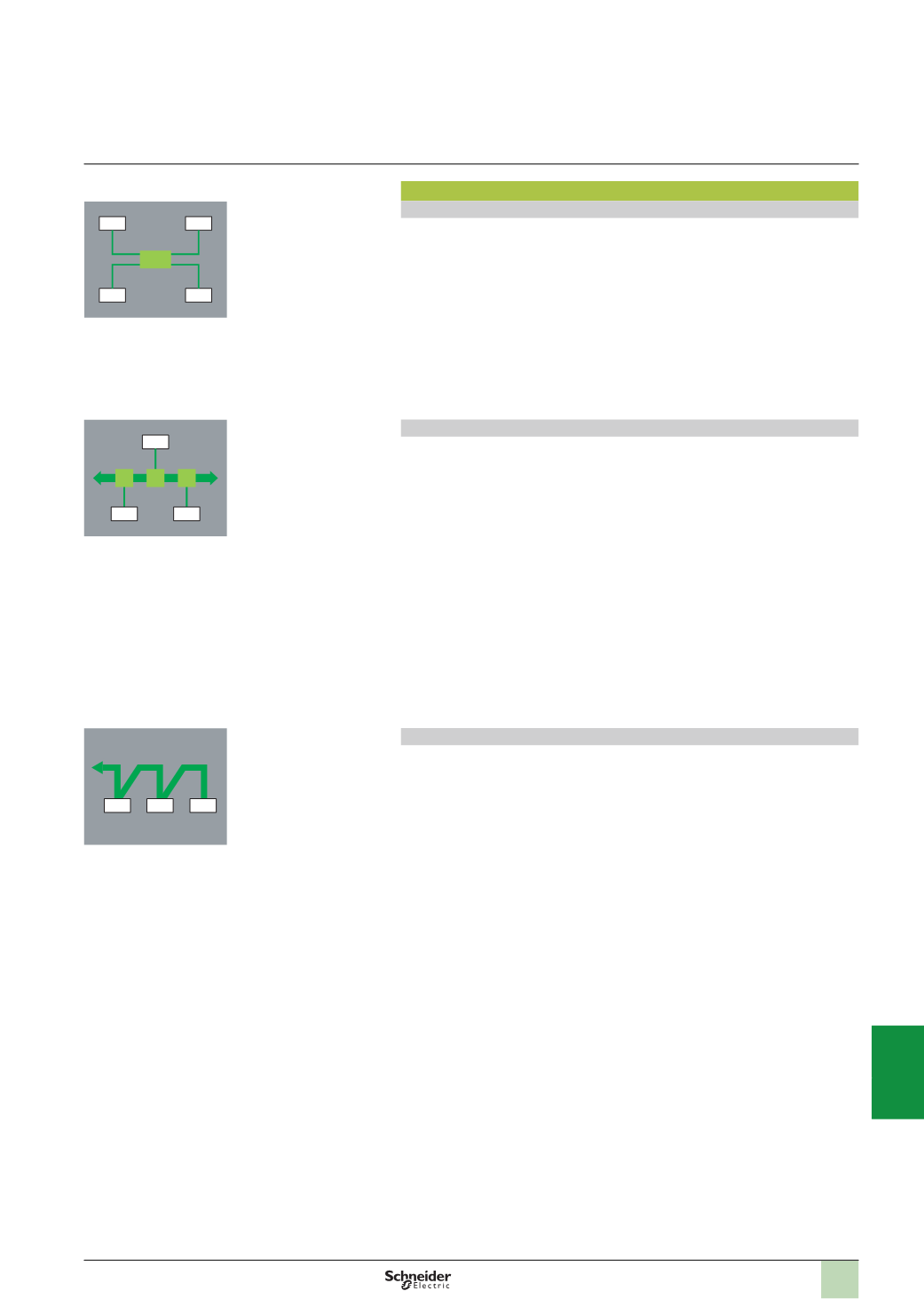
Star topology
In a star topology, all devices are connected though an intermediate device.
Ethernet Star
In an Ethernet star the intermediate device may be a
hub
or a
switch
.
Star is the
commonly used topology in corporate networks and as of today is adopted in almost
every automation application. As mentioned previously, for industrial Ethernet
applications the use of full duplex switches as central device rather than hubs is
strongly recommended.
Deploying Star topologies with ConneXium
With any of the hubs and switches offered by the ConneXium offer, star topologies
can be implemented.
Bus topology
The bus is one of the most adopted topologies in traditional industrial automation
networks. A single trunk cable connects all the devices on the network usually via
passive or active T-connectors, or directly chained (daisy chain). Devices usually
can be installed anywhere along the bus.
Ethernet Bus
An Ethernet bus can be deployed by interconnecting
hubs
and/or
switches
in line
and considering every one of them as the connection for a drop device. A limited
number of hubs and an unlimited number of switches can be interconnected to
achieve this purpose.
Deploying Bus topologies with ConneXium
With any of the hubs and switches offered by the ConneXium offer bus topologies
can be implemented.
Specially suitable for this purpose are the switches with 1 or 2 fiber optic ports:
b
The 2 fiber optic ports switches could be for connection of inline devices.
b
The single fiber optic port switches could be used for the connection of end line
devices.
Daisy chain topology
Daisy chain -along bus- is the other most adopted topology in traditional industrial
automation networks. Cable segments interconnect multiple devices, being the
devices “part ” of the network cable.
Ethernet daisy chain
Daisy chain is not today a very common Ethernet topology, but it will soon become
one of the most popular ones when enough quantity of devices is made available.
In Ethernet daisy chain the devices have:
b
2
Ethernet ports
and
b
1
embedded switch
.
Schneider Electric is releasing to the Industrial market Industrial Ethernet devices to
be connected in daisy chain architectures.
Deploying daisy chain topologies
To deploy daisy chain topologies, no hubs or switches are required. All devices have
an embedded switch.
Dual port Ethernet at the device level is an absolute integral component for
daisy chain topologies.
One port of the device connects to one port of the neighboring device on either side
of the device. These neighboring connections make up the daisy chain.
Ethernet switches can be employed in a daisy chain topology when multiple scan
chains are in use by the controlling device. It is expected that the Ethernet switch will
be located near the controlling device with the different scan chains emanating from
the switch.
DTE
DTE
DTE
DTE DTE
DTE
DTE
DTE
DTE
DTE
2
1
3
4
5
6
7
8
9
10