



 24 / 413

1/18
Functions,
references
Memory structure
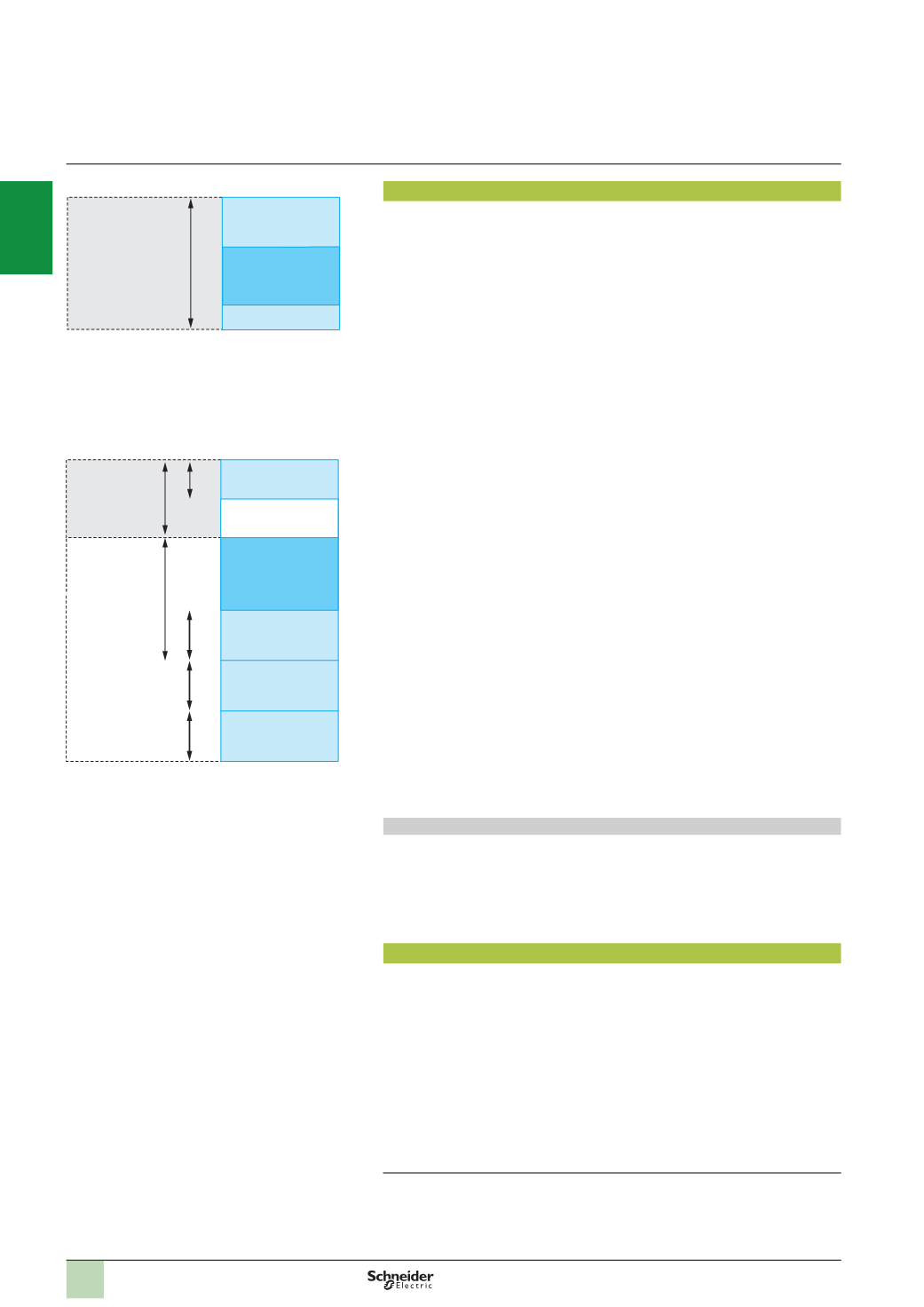
The application memory is divided into memory areas, which are physically
distributed across the internal RAM memory and the PCMCIAmemory extension
card(s):
b
The application data area is always in the internal RAM.
b
The application program area is in the internal RAM or the PCMCIAmemory card
b
The constants area is in the internal RAMor the PCMCIAmemory card.
There are two ways of organizing the application memory for
TSX P57 1
p
3
M/2
p
3
M/2
p
23
M
and
TSX P57 3
p
3
M
/
3623
M
/
453
M
/
4823
AM
processors with or without a memory extension installed in the form of a PCMCIA
format card.
Application in internal RAM
The application is completely loaded into the processor's battery-backed internal RAM
(1)
,
the capacity of which depends on the processor model (32 to 96 Kwords).
For example, the
TSX P57 1
p
3
M
processor has 7.5 Kwords of application data and
24.5
Kwords of program, constants and system data
(2)
.
The memory space (32 Kwords) is shared between the application data, the
program, the constants and the system data
(2)
.
Application in the PCMCIA card (slot no. 0)
The internal RAM is then reserved for the application data.
The PCMCIA card contains the program and constants (64 to 512 Kwords).
The file storage area of 128 K or 640 Kwords (depending on the model of PCMCIA
card) can be used in remote applications, for storing information such as production
data, production recipes, etc.
The symbols storage area of 128 K or 256 Kwords (depending on the model of
PCMCIA card) enables the application symbols database to be stored on the PLC.
Extension of the additional data storage area (slot no. 1)
This area, containing 128 or 640 Kwords, can be extended up to 2688 Kwords by using
an SRAM
TSX MRP DS 2048P / MFP 004M
PCMCIAmemory card. This card is inserted
into the lower slot on
TSX P57 2
p
3
M/2
p
23
M
,
TSX P57 3
p
3
M/3623M/453M/4823AM
processors and can be used in conjunction with memory extension cards (type 1 in the
upper slot).
Data in internal RAM
The data area can be extended to up to 30.5 Kwords. It is only supported by the
PLC's internal RAM.
PL7 Junior/Pro software helps the application designer to manage the structure and
organize how the memory space on the Premium PLC is occupied.
Protecting the application
Regardless of the PLC memory structure (whether the application is located in the
internal RAM or on the PCMCIA card), it is possible to protect the application so that
it cannot be accessed (for the purpose of reading or modifying the program) in online
mode under PL7 Junior/Pro.
Amemory protection bit, set in configuration mode, is also available to prevent any
program modification (via the programming terminal or downloading).
Premium processor references
TSX 57 10/20/30/40
processors are equipped with:
b
A PCMCIA slot (no. 0) that can accommodate a memory extension or SRAM
memory card for storing additional data
b
A PCMCIA slot (no. 1) that can accommodate a communication or memory
extension card for storing additional data
b
Two terminal ports (8-way female mini-DIN type), Uni-Telway or character mode.
TSX 57
processors are double-format modules (except
TSX P57 1
p
3
M and
TSX P57 353LAM
processors, which are single-format).
TSX 57 30/40
processors support the loading of programs, via the terminal port, at a
maximum speed of 115 Kbit/s (limited to 19.2 Kbit/s for
TSX 57 10/20
processors).
The integrated Fipio link (bus manager) on
TSX 57 20/30/40
processors supports a
maximum of 127 connection points. The link on the
TSX P57 153M
processor is
limited to 63 connection points.
(1)
The internal RAM is protected by an optional battery with a life of 3 years, which is located in
the power supply module.
(2)
The system has a minimum reserve RAM memory area of around 5 Kwords. Please refer to
the PL7 Micro/Junior/Pro reference manual.
Modicon Premium automation
platform
PL7 processors
4
4
1
2
3
Internal RAM
PCMCIA card
(
slot no. 0)
Data
Program
Constants
Additional data
storage
Symbol storage
32
to 176 Kwords
30.5
Kwords
64
to 512 Kwords
32
Kwords
128/640
Kwords
128/256
Kwords
Processor with PCMCIA card
1
Application data (30.5 Kwords max.)
2
Task descriptor and executable code
3
Constant words, initial values and configuration
4
Depending on the PCMCIA card model.
1
2
3
Internal RAM
Data
Program
Constants
32
to 96 Kwords
Processors without PCMCIA card
1
Application data (30.5 Kwords max.)
2
Task descriptor and executable code
3
Constant words, initial values and configuration
2
1
3
4
5
6
7
8
9
10