


 592 / 759

 mkelectric.co.uk
CIRCUIT PROTECTION
592
Sentry Technical
Industrial 10kA Residual Current Devices (RCDs)
Direct Contact
Defined as “contact of persons or livestock with live parts”.
The Regulations recognise four main means of providing
protection against direct contact which include enclosures and the
use of extra low voltage systems.
However, the use of RCDs is specified by the Regulations in the
following instances:
l
A socket outlet rated at 32A or less which may reasonably be
expected to supply portable equipment for use outdoors shall
be protected by an RCD having the characteristics specified in
Regulation 412‑06‑02. (Regulation 471-16-01 applies.)
l
Where socket outlets are used to supply caravans on caravan
sites, then they must be protected by an RCD having the
characteristics specified in Regulation 412‑06‑02
Regulation 412‑06‑02 stipulates among other things that where
supplementary protection is provided by residual current devices,
their rated residual operating current must not exceed 30mA and
that they must trip within 40ms at 5 times rated operating current.
Although RCDs must never be used as the sole method of direct
contact protection, they are invaluable in providing supplementary
protection in high risk environments where damage may occur.
Typical applications include situations where equipment may be
used outside or fed by trailing sockets, equipment accessible to
children or equipment used in wet areas.
For these reasons RCDs are commonly found in schools,
hospitals and residential installations.
Application (continued)
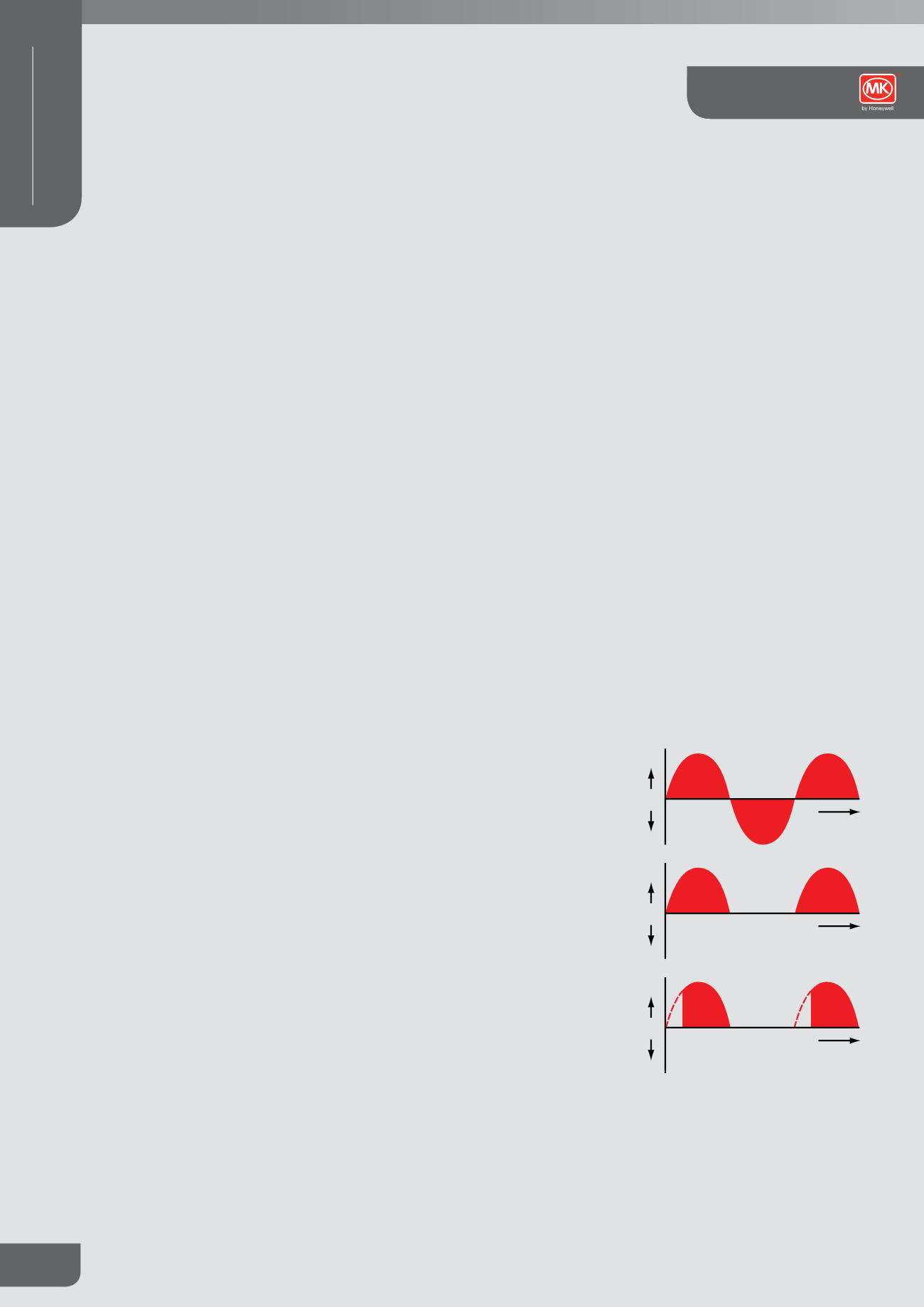
t
i
Normal a.c. waveform
t
i
Pulsating d.c. waveform
Half wave rectified
t
i
Pulsating d.c. waveform
Typical asymmetrical
phase control
3. Types of fault current
In an installation different types of fault current can occur.
MK offer RCDs to suit these conditions.
Sentry Type AC RCDs are suitable for situations where there are
residual sinusoidal alternating currents, whether applied suddenly
or rising slowly. This is the most commonly used type of RCD in
the UK.
Sentry Type A RCDs (i.e. pulsating d.c. fault current sensitive)
are suitable for situations where there are residual sinusoidal
alternating currents, whether suddenly applied or slowly rising.
These situations can occur with the use of semiconductor devices
in modern electrical and electronic equipment, such as computers,
printers, plotters, televisions, video cassette recorders and hi-fi
equipment, is growing.
Such devices may result in the normal sinusoidal a.c. waveform
generated by the mains electrical supply being ‘modified’. for
example, the waveform may be rectified or, as in asymmetric
phase control devices, the waveform may be chopped.
The resulting waveforms are said to contain a pulsating d.c.
component as illustrated below.