



 393 / 582

BETA Switching
Timers
7
LF5 mechanical time switches
9/15
Siemens ET B1 · 10/2008
9
■
More information
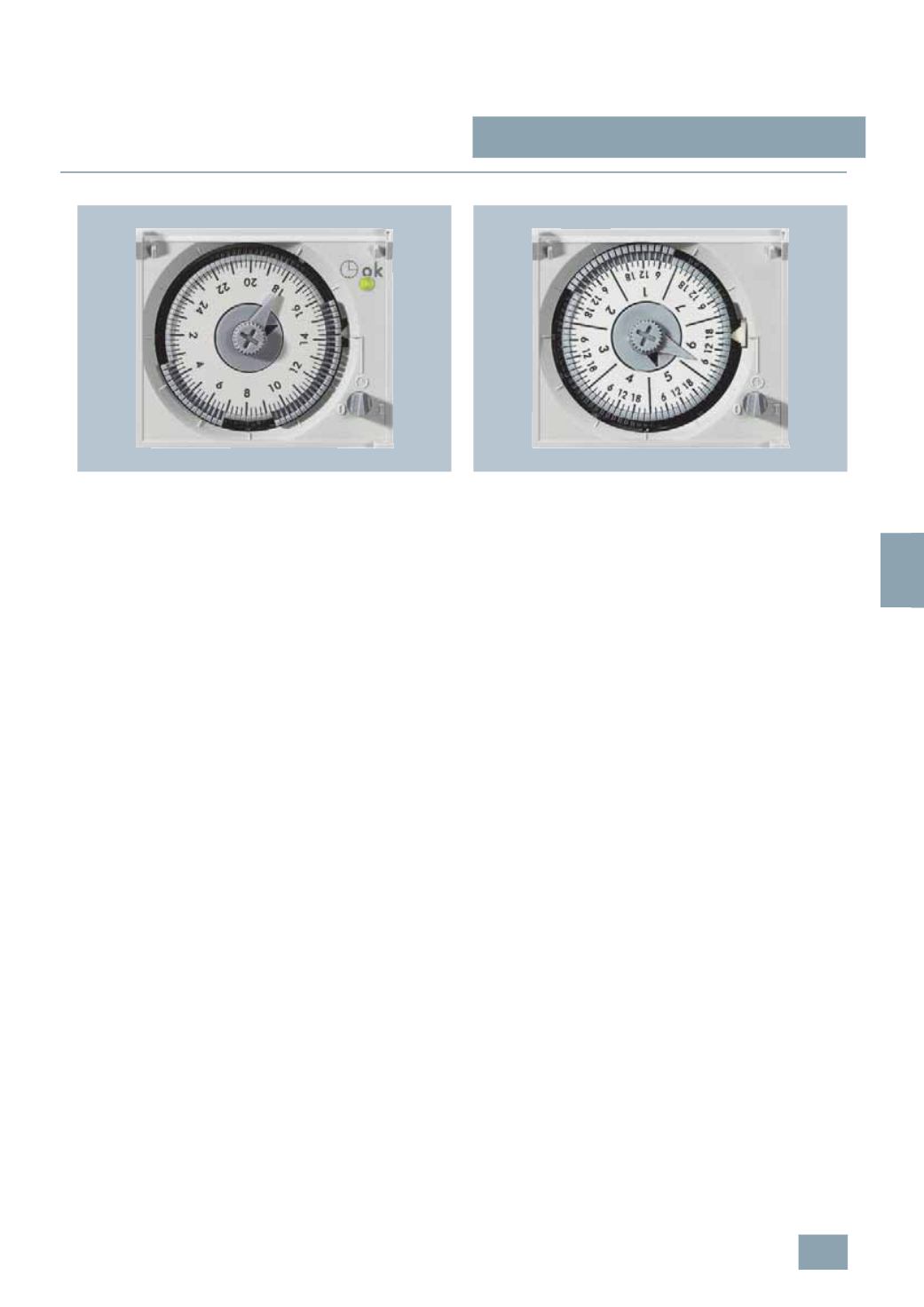
Mechanical time switches with day disk
Synchronous time switches without power reserve
The control gear is driven by a synchronous motor so it is
dependent on the power supply frequency. If this frequency is
unstable, the devices cannot be used. In the event of a power
failure, the time switch will stop.
Quartz-clock time switches with power reserve
A quartz electronic circuit supplies the drive with a stabilized
frequency so that the time switch is not dependent on the power
supply frequency. In the event of a power failure, the time switch
continues to operate on its power reserve.
Automatic make ready system
This supports fast and easy installation of the 7LF5 301-4 and
7
LF5 301-5 time switches. These time switches self-adjust
during commissioning in fast mode to the correct time and
correct day within the Central European time zone. They also
automatically set the correct time for daylight saving. A further
advantage is the quartz-precise adjustment of the correct
time and the correct day as soon as the supply voltage is
reconnected after a power failure.
Precision quartz mechanism
Clock accuracy: the internal precision clockwork has an
accuracy of
±
1
min. per year. Until now, this accuracy and
automatic operational safety was only offered by digital time
switches.
Optimization of energy consumption through minimum make
and break cycles of 15 minutes: it is possible to set the switching
times in 15-minute patterns, with a switching interval of at least
30
minutes.
Mechanical time switches with week disk
LED display
The adjustment data for Central Europe are stored and an LED
provides information on the current state.
So: simply unpack, snap into place, connect and set the desired
switching times – no tools required! This saves time and money.
Clear design
Extremely intuitive – thanks to clear design. The switching times
are easily recognizable.
With the weekly time switch, the make and break cycles are only
120
minutes with a minimum switching interval of 240 minutes.
© Siemens AG 2008