


 20 / 51

2010
CA08103002Z-EN
www.eaton.comSwitchgear for North America 22/7
The reason that the selection pages
for all product groups and this chapter
of the main catalog contain specific
information about approvals and
devices for use in North America is
that:
•
through the activities of machine
and panel builders a large
percentage of the products are
indirectly destined for export;
•
North American codes and
standards that are less well known
and that deviate significantly from
the IEC and EN standards must be
observed;
•
for export projects, devices
approved for NA must always be
used;
•
NA-approved devices often have
different ratings and sizes and are
often used and combined in ways
that differ from usual IEC and EN
practice;
•
the customs and standard prac-
tices in the North American market
must also be taken into consider-
ation;
•
with the information in this catalog
customers striving to build
machines for the world market can
see that they can largely use the
same Eaton devices for all
markets;
•
interesting new products are now
available for this field of business;
•
customers expect or are
demanding a supportive business
relationship.
Because Eaton wants to make export
as simple as possible for its
customers, we have made compre-
hensive improvements to this catalog
following intensive discussions with
our exporting customers. Although the
catalog contains mainly Moeller
products, Eaton’s sales companies
can, in some cases – for example
circuit breakers – supply other
Eaton-
branded products
approved for North
America.
This article provides only a summary of
this topic
1)
.
For further information
about approvals for export to North
America, see Moeller’s detailed
Technical Essays
2)
.
For an explanation
of special terminology, see the
glossary in this catalog on page 22/22.
“
North America” or “NA” always
refers to the USA and Canada.
In the USA the legally binding OSHA
3)
and the NEC
4)
require an approval of
devices and plants. The necessary
testing and certification can be
performed by various “Nationally
Recognized Testing Laboratories”
(
NRTL), of which the Underwriters
Laboratories (UL)
5)
are the best-known
and most widely accepted. Alterna-
tively, approvals and approval marks
can be issued by approved subsid-
iaries of German Technische Über-
wachungsvereine (TUV)
6)
or by ETL-
Intertek
7)
,
which is also active within
Germany. Approvals can not be based
on testing by the manufacturer only.
Testing and approval by an indepen-
dent third-party is always required.
In Canada, all electrical apparatus
must comply with the CEC
8)
,
which
requires that all equipment and
installations have been approved by
CSA
1)
or equivalent bodies.
In addition to the normal UL and CSA
approvals, the trade regulations
resulting from the NAFTA agree-
ments
10)
allow vendors to apply for a
joint UL and CSA approval at all
approval organizations. The devices
then carry a logo that should be recog-
nized in both countries. To date, Eaton,
and previously Moeller, have rarely
made use of this approval method
because these combined approvals
are still not fully recognized by local
inspectors and end users. Eaton
strives to help its customers avoid
problems with approved devices in
North America.
A special characteristic of the North
American market is that, with few
exceptions, electrical equipment must
be acceptance-tested on-site by so-
called Authorities Having Jurisdiction
(
AHJ). These authorities check that all
components have the required
approvals. In addition, the components
must be approved for their application
according to the standard applicable
in each case, i.e. they must be
correctly dimensioned, combined and
used according to the NEC or CEC
codes as well as any applicable
standards. Device combinations
approved on behalf of the component
manufacturer – for example motor
starter combinations – usually exhibit
better technical data than combina-
tions of individual devices that are not
tested as combinations. The reason for
this is that the components support
each other in their switching tasks.
This is an important aspect, for
example, for the “Overall Short Circuit
Current Rating”
11)
.
Many machine and
panel builders have their end products
(
such as machines)approved already
at the point of manufacture, while
some even have their own approved
workshops.
The codes and standards of the USA
and Canada differ – to some extent
significantly – from those of other
industrial countries, which use the
IEC/EN standards
12)
.
Keep in mind that
the USA and Canada publish their own,
independent standards, which do not
always have an identical content, and
which may require different approvals.
Eaton offers two groups of electronic,
switching and protective devices
approved for North America:
1)
Preferably as
world-market
devices
with the following key
characteristics:
World-market devices fulfil all device
and product standards and feature all
relevant approvals (see approvals
overview from page 22/5), including
the North American approvals, and
can be used throughout the world.
World-market devices have rating
plates with all important technical data
for worldwide use and for use in in the
1.USA and Canada. IEC/EN rating data
has no relevance for use in North
America.
For unrestricted sale in European
Union member states, world-market
devices contain the CE mark.
Examples of
world-market devices
include:
Pilot (control circuit) devices, cam
switches, position switches,
contactors, motor-protective circuit
breakers, overload relays, measure-
ment and protective relays, electronic
devices and systems, user-program-
mable PLCs. These are, on the whole,
the devices covered by standards
UL 508 and CSA C22.2 No. 14-05.
2)
Device versions
for North America
Where the combination of the require-
ments of all codes and standards in a
single product range is uneconomical
or not possible, these devices have
been developed by modifying existing
IEC/EN devices. In some cases, the
cost of approval depends on the
devices’ production quantity, which is
viable only for products that will be
exported.
The devices Eaton terms
“
NA devices”
(
Listed Components) or
“
CNA devices”
(
Recognized Components) have the
following key characteristics:
These products have been approved
to UL and CSA and can be used in the
USA and Canada as well as in other
countries if the end client requires UL
and CSA approvals or conformance
with with the North American
standards
13)
.
They have ratings plates containing at
least all important data for use in the
USA and in Canada. But because
these devices will also be exported
from the USA or Canada, their rating
plates usually also contain data to IEC
and EN standards. Devices with
IEC/EN data also carry the CE mark
and the CCC mark for China.
They are largely identical with the
IEC/EN devices of the same series but
differ in their detail design or feature
slightly lower ratings, depending on
the approval requirements. If the
reduced technical data does not
present a problem, these devices can,
like world-market devices, be used
throughout the world. Some major
customer do this to reduce the number
of versions.
With rare exceptions, the IEC/EN and
the NA versions have the same
external dimensions and can usually
(
depending on approvals) be equipped
with the same accessories, such as
auxiliary contacts or shunt releases.
The existing approvals for the USA and
Canada are included in the devices’
part numbers as a part number
suffixes, and are indicated on rating
plates by the corresponding approval
marks as follows:
Eaton has special
North America
versions
for:
Circuit breakers NZM, molded case
switches NS…-NA and miniature
circuit-breakers FAZ (see additional
information about FAZ, FAZ-NA,
FAZ-RT in Chapter 19 of this catalog).
Recognized Components are
frequently and incorrectly used
without regard for the additional
Conditions of Acceptability (CoA)
contained in the product standards.
This is known to the inspectors, who,
for this reason, are particularly
thorough in checking the correct use
of these devices. Incorrect usage of
Recognized Components is likely to be
noticed and will result in a denial of
commissioning until corrective
measures have been taken. Special
care should therefore be taken here.
Technical data and approval
status for North America
This main catalog contains all
approved technical data for the North
American market for engineering
switchgear systems, such as control
panels for the electrical equipment
of machines and plants
14)
.
Power
distribution systems are rarely
exported, and further approvals
would be required for them
15)
.
When
engineering switchgear systems for
North America, the applicable North
American standards should be
obtained under all circumstances.
For the first time in this catalog, the
selection pages include a clear,
precise indication of each product
approved for the North American
market, using flag symbols for the USA
and Canada. This level of attention is
paid to the approvals for North
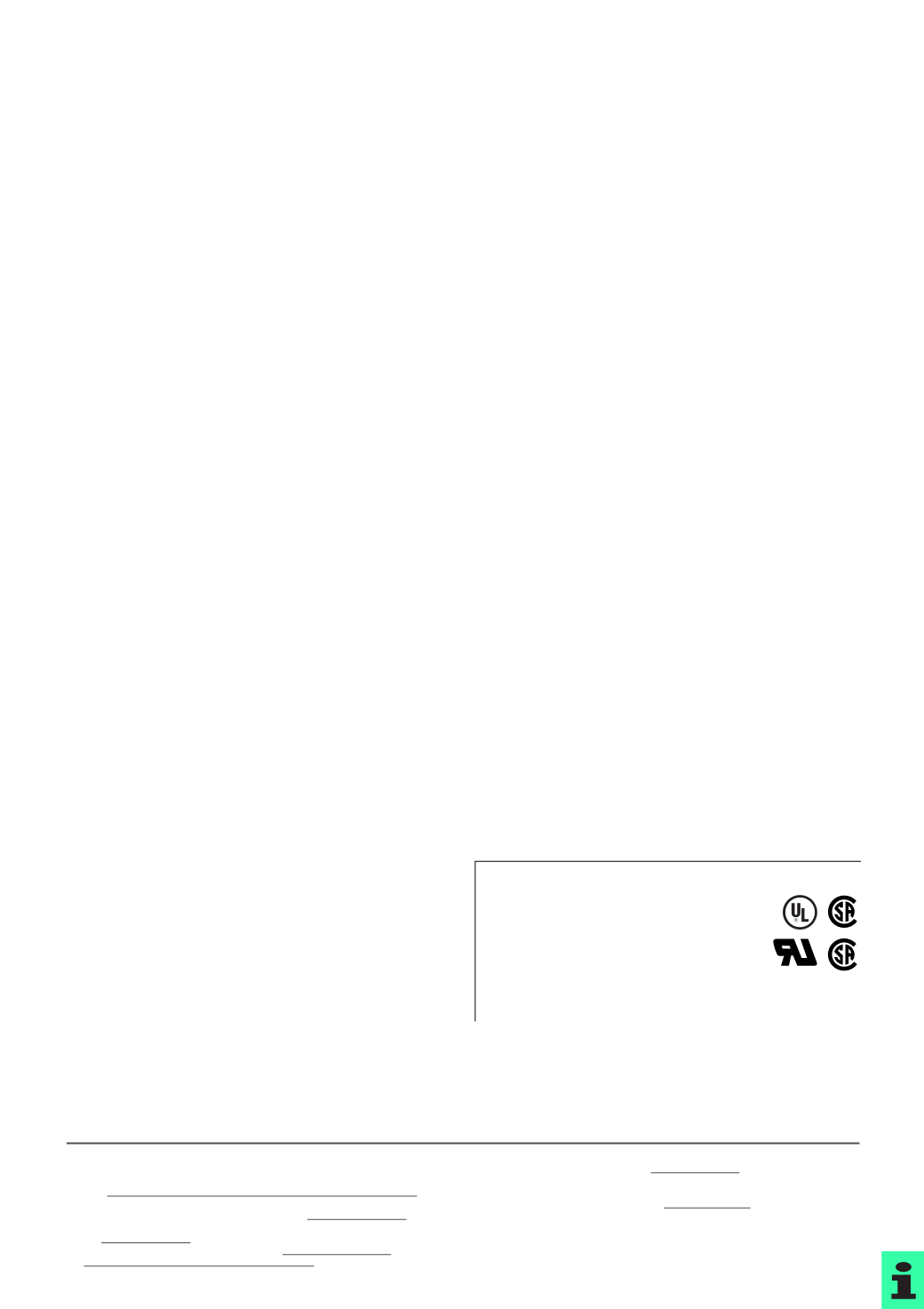
Partno.
suffix
Type of approval
Approval mark
-
NA For use in the USA the device is approved as a
single device as
“
Listed Component”
;
in Canada
it is a
“
Certified Component”.
-
CNA For use in the USA the device is approved as a
“
Recognized Component”
;
for Canada as a single
device it is a
“
Certified Component”.
For use in the USA, additional
“
Conditions of
Acceptability (CoA)”
must often be adhered to
according to North American standards.
Notes
1)
Date of described Codes and Standards, and development and approval status:
January 2010
2)
See:
http://www.moeller.net/de/company/news/publications/index.jsp,
The papers are also available free of charge in print
3)
Occupational Safety and Health Administration,
http://www.osha.gov4)
National Electrical Code
5)
UL,
http://www.ul.com6)
e.g. TUV Rheinland of North America, Inc.,
http://www.tuv.com/us7)
http://www.intertek.com,http://www.intertek.de
8)
Canadian Electrical Code
9)
Canadian Standards Association,
http://www.csa.ca10)
North American Free Trade Agreement, between USA, Canada andMexico
11)
SCCR, short-circuit strength of the switchgear systems
12)
International Electrical Commission,
http://www.iec.ch ,EN = European standards
13)
e.g. in offshore area, or if the plant is to be used in different locations
throughout the world
14)
e.g. Industrial Control Panels for Machinery, UL 508A and NFPA 79
15)
For example testing in specific distribution board enclosures