


 16 / 51

Approvals and shipping classifications for world markets
2010
CA08103002Z-EN
www.eaton.com22/3
In their basic version, the
Moeller-branded Eaton devices
are approved for use throughout
the world, including the USA and
Canada. As such, they can be
used without restriction as
devices for world markets.
The standard versions of some
devices, such as circuit breakers,
can be used worldwide except in
the USA and Canada.
For export to North America,
numerous devices are available
in special UL- and CSA-approved
versions.
For currently available approvals, see
our website:
https://wss.moeller.net/
approbationen/step1.do
Eaton’s Moeller-branded low-voltage
switchgear and switchgear assem-
blies conform to national and inter-
national specifications, making it
possible to construct control systems
that will conform to the national and
international specifications of any
country in the world.
This, of course, means that due
consideration must be given to the
national standards of the respective
country, such as those concerning
installation, operation, installation
materials and methods, as well as any
pertaining to circumstances such as
severe environmental conditions.
The device rating data given in this
catalog for 220 – 240 V, 380 – 440 V,
500
V, 600 V, and 690 V covers virtually
all existing three-phase systems
worldwide.
Deviating requirements for the USA
and Canada are given in detail in each
chapter of this catalog. Read also the
detailed description “Switchgear for
North America” from Page 22/13.
For the worldwide use of switchgear,
special installation standards and
approval requirements must also be
observed in addition to the widely
differing system conditions:
Where screw fuses are used in a
control system, some European
countries – such as Denmark, Finland,
the Netherlands, Norway and Sweden
–
require gage screws. In this case,
“
FORM P” fuse bases must be used.
Switzerland no longer requires the
use of gage screws, but they are still
often requested by customers.
The majority of countries permit the
import of switchgear assemblies and
devices on the manufacturer’s
undertaking that they have been
constructed in accordance with the
pertinent specifications. In some
countries, such as the USA and
Canada, however, there is a legal
obligation to obtain official approval.
In these countries, devices and
enclosures – sometimes even
complete control systems – are
tested and approved by independent
bodies.
In Scandinavia and in Switzerland, an
official approval for low-voltage
switchgear and controlgear had to be
sought to some extent. For industrial
switchgear, this legal obligation has
now been abolished, provided the
devices have been manufactured and
tested in accordance with harmonized
European standards (such as
IEC/EN 60947). There is then no longer
a requirement for them to carry their
country’s own approval mark. Eaton
develops switchgear to international
standards, such as IEC/EN 60947 and
applies the corresponding marks.
Devices that conform to the European
Low-Voltage Directive and are sold
within the European Union must
contain the CE mark.
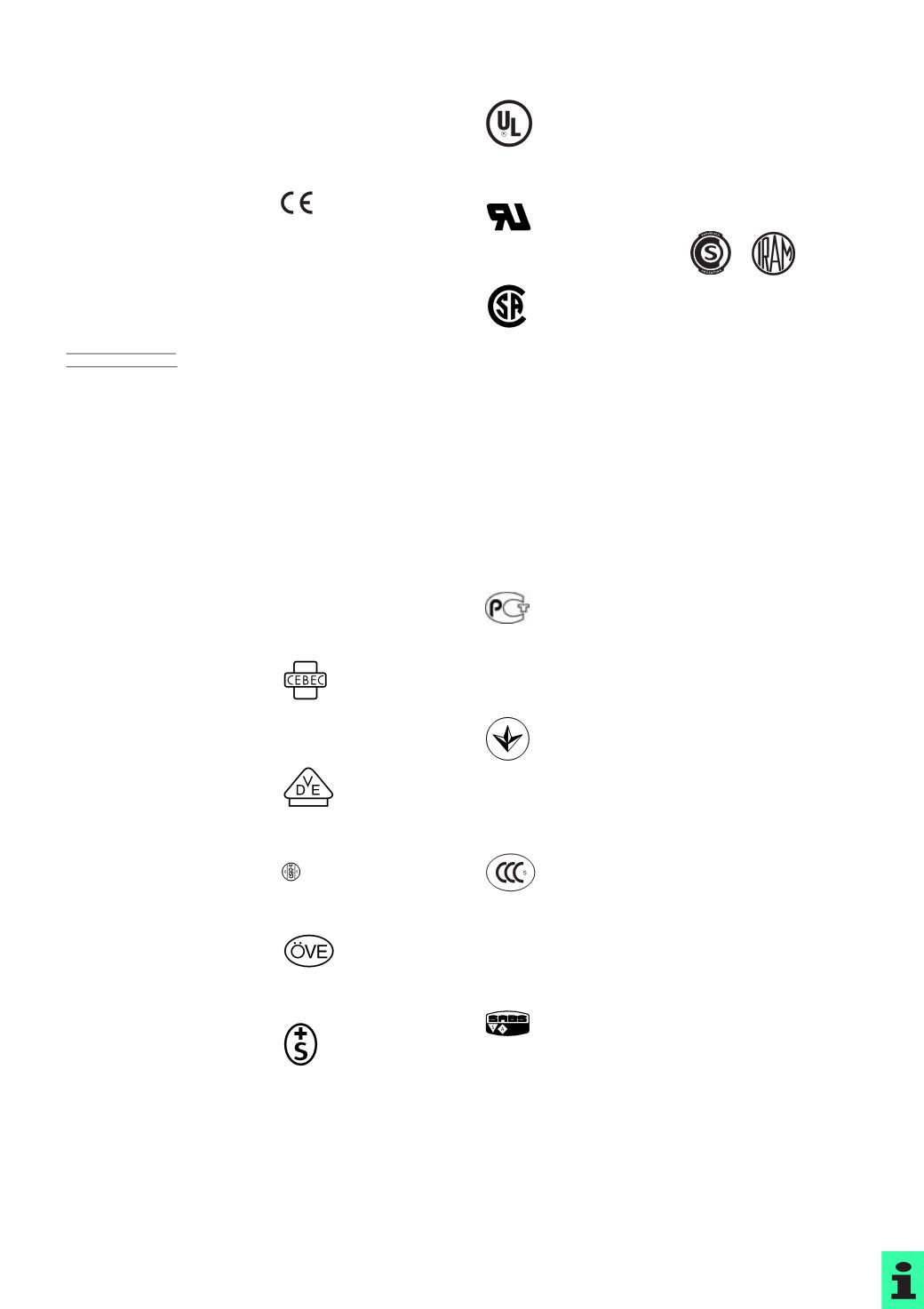
Europe,
Conformité Européen (CE)
The CE mark indicates that the device
corresponds with all relevant require-
ments and standards. Mandatory
marking allows unrestricted use of
marked devices within the European
economic area.
Devices sold within the European
union must comply with the Electro-
magnetic Compatibility (EMC)
Directive. Eaton has performed the
required tests for all Moeller-branded
products subject to this Directive
and applied the CE mark, which
demonstrates compliance with the
EMC Directive.
Because devices bearing the CE mark
comply with the harmonized
standards, approval and the
associated marking is no longer
required in the following countries:
Belgium, Denmark, Finland, France,
the Netherlands, Norway, Sweden,
and Switzerland.
An exception is installation material.
In some areas, miniature circuit
breakers and residual current device
must still be labeled and therefore
carry the corresponding approval
mark.
Belgien, Comité Electrotechnique
Belge/Belgisch Elektrotechnisch
Comité (CEBEC)
Germany, Verband Deutscher
Elektrotechniker (VDE)
France, Union Technique
de l‘Electricité (UTE)
Austria, Österreichischer Verband
für Elektrotechnik (ÖVE)
Switzerland, Schweizerischer
Elektrotechnischer Verein (SEV)
Devices for export to the USA and
Canada have either additional UL and
CSA approval or are available in a
separate version with UL and CSA
approval.
USA, Underwriters Laboratories
(
UL) - Listing
USA, Underwriters Laboratories
(
UL) - Recognition
Canada, Canadian Standards
Association (CSA)
Approval for electrical products is
also required in Argentina, China,
Russia, South Africa, and the Ukraine.
Marking is partly mandatory for these
countries. As in other European
countries, the IEC rating data is
accepted here.
Romania requires that components
that are to be used in public buildings
must be approved by the Romanian
test authority ICECON.
Russia
Devices for Russia must bear the
appropriate marking.
Russia, Goststandart (GOST-R)
Ukraine
Devices for the Ukraine must bear
the appropriate marking.
Ukraine, Goststandart (Ukrain-GOST)
China
Devices for China must bear the
appropriate marking.
China,ChinaCompulsoryCertification(CCC)
South Africa
In South Africa approval is mandatory
for circuit breakers and busbar trunking
systems: These devices must bear the
appropriatemarking.
South Africa, South African Bureau of
Standards (SABS)
Argentina
In Argentina, mandatory approval is
based on Resolution 92/98. From April
01, 2001,
miniature circuit breakers
and residual-current circuit breakers
are subject to mandatory approval.
As of this date, circuit breakers up to
I
e
= 63 A and U
e max
= 440 V must carry
the following marks:
Argentinien, Instituto Argentino de
Normalización y Certificación (IRAM)
Selection of devices
In addition to the required approvals
and conformance with applicable
regulations, the design of devices and
systems themselves must be suitable
for the target market.
Points to keep in mind when selecting
switchgear for export include:
Motor-protective circuit breakers
Use auto-protected circuit breakers,
which are capable of controlling the
highest prospective fault levels at the
point of installation without the need
for back-up protection.
Advantages
Can be positioned anywhere and are
fully independent of the local circuit-
protection system; no spare part
problems
Circuit-breakers
Use makes with visible contacts, and
quick-make and quick-break opera-
tion as standard. For high short-circuit
levels, use current-limiting circuit
breakers. Selective switches are
recommended for the selective
graduation of networks.
Advantages
Independence from local accident
prevention regulations requiring
visible contacts, and safety from faults
caused by inexperienced operating
personnel. The effects of short-
circuits are kept to a minimum.
Fuseless installations offer greater
safety and reliability in plant
operation. In the event of a fault,
only the faulty section of the system
is isolated.
Contactors
Use contactors whose entire range
provides consistently reliable
operation in the event of voltage drops
(80%
Un should be aimed for) and
whose contact system will not
assume an indeterminate position
on closing or opening under these
conditions.
Advantages
During the electrification work in
areas such as Africa and the Middle
East, an insufficient voltage stability is
–
at least for a certain time – likely in
many applications (for example due to
long spur lines or small local genera-
tors). The use of devices that fulfil the
above requirements will eliminate one
of the main failure causes related to
contactors.
Enclosures
Use insulated enclosures with trans-
parent covers (i.e. “totally insulated”
enclosures).