


 261 / 274

261
+44 (0)1243 838999
Technical
Communication protocols
Communications protocols are the method of transmitting information to the light fittings.
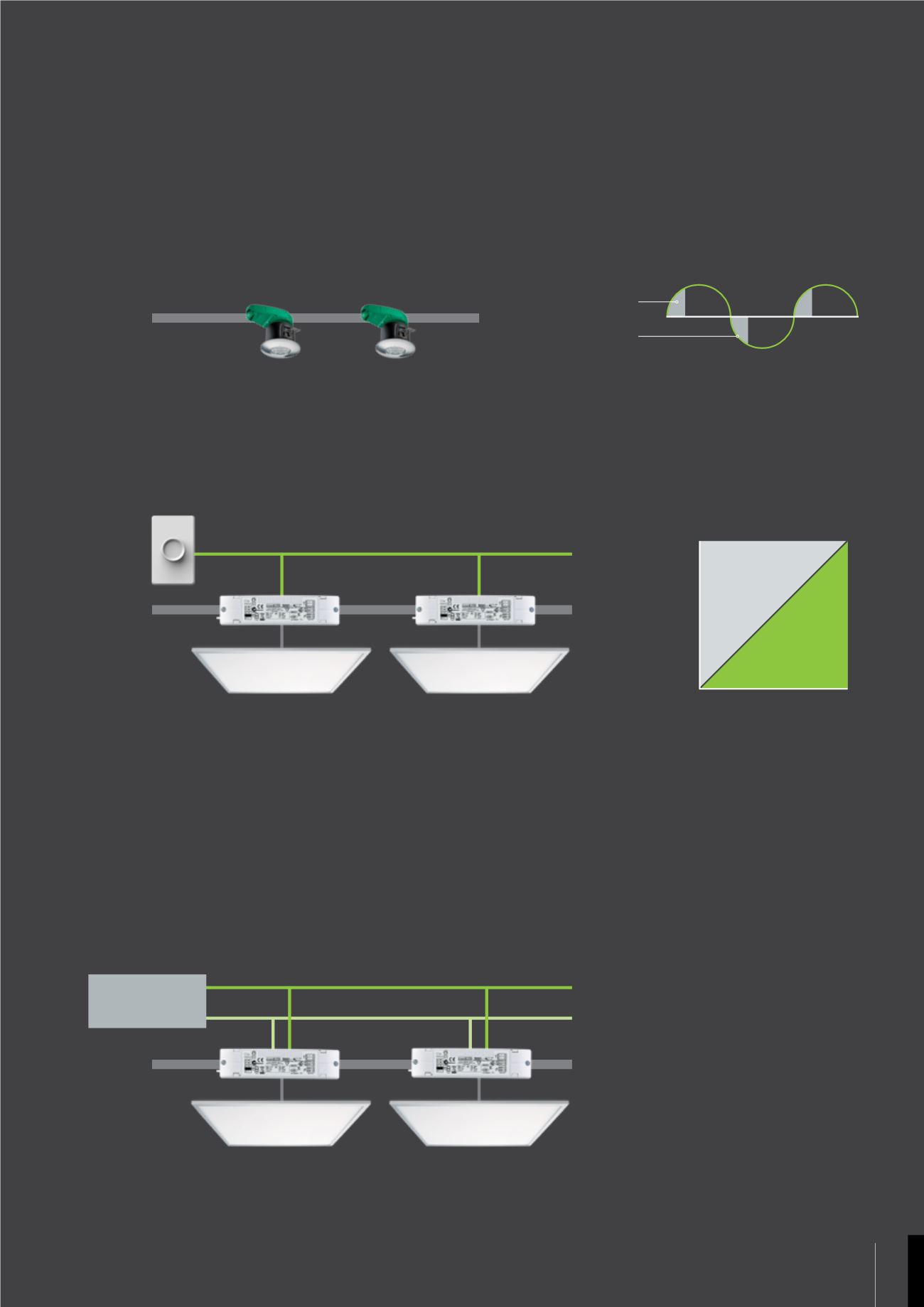
PHASE DIMMING
Uses the mains alternating current (AC) to reduce power to the light fitting by cutting out sections of the AC supply. Phase dimming
was designed for traditional lighting technology and is common in lower power domestic lighting but is unsuitable for commercial
applications due to the larger power requirements.
The supply can be cut from:
- The front of the AC wave (leading edge dimming) and/or
- The back edge (trailing edge dimming)
This method of control is a low current system (typically 1mA) meaning it can be run along relatively thin cables with
little voltage drop and depending on dimmer manufacturer recommendations, allows for up to 50 LED dimmable drivers
on one wall mounted dimmer.
DALI (DIGITAL ADDRESSABLE LIGHTING INTERFACE)
This is a digital communications protocol that was developed for the lighting industry. A separate control wire or BUS
is used to send digital information to light fittings and allows the individual light fittings and sensors to communicate
with an advanced lighting control system. Although DALI is a standard protocol beware of mixing components between
manufacturers without first testing. Along with the correct LED driver the DALI system requires additional control
equipment including DALI BUS controllers, power supplies, sensors and user interfaces.
DSI (Digital Serial Interface)
– developed by Tridonic, the driver manufacturer. The specification is simpler than DALI but
doesn’t have the same general industry support.
240V Input
240V Input
Dimming
Leading edge
• Separate control wire not required
• For lower power applications
• Fully programmable lighting sleeves
• Individually addressable light fittings
240V AC
240V Input
Data 1
Data 2
Ethernet
Maximum 64 light fittings
or 300m per circuit
DALI
Control
System
240V AC
240V AC
Separate 1-10v control wire may need screened cable
1-10V
Dimmer
100%
50%
0%
0v
5v
Voltage
Lumens
10v
• No setup, easy installation
• No third party commissioning or site visit
1-10V Input
1-10V Input
1-10 VOLT ANALOGUE
Uses a separate control wire to notify the driver that the power to the LEDs should be changed. The separate control signal is a direct
current (DC) and can be adjusted from 1 up to 10 volts, the voltage level is interpreted by the driver to set the LED power.