



 82 / 105

82
Thomas & Betts Ltd., Emergi-Lite, Bruntcliffe Lane, Morley, Leeds, LS27 9LL • Tel: +44 (0)113 281 0600 •
Email:
emergi-lite.sales@tnb.com• Web:
www.emergi-lite.co.ukTechnical reference
In addition to these points of emphasis,
the following need to be considered
when planning emergency lighting.
Escape routes
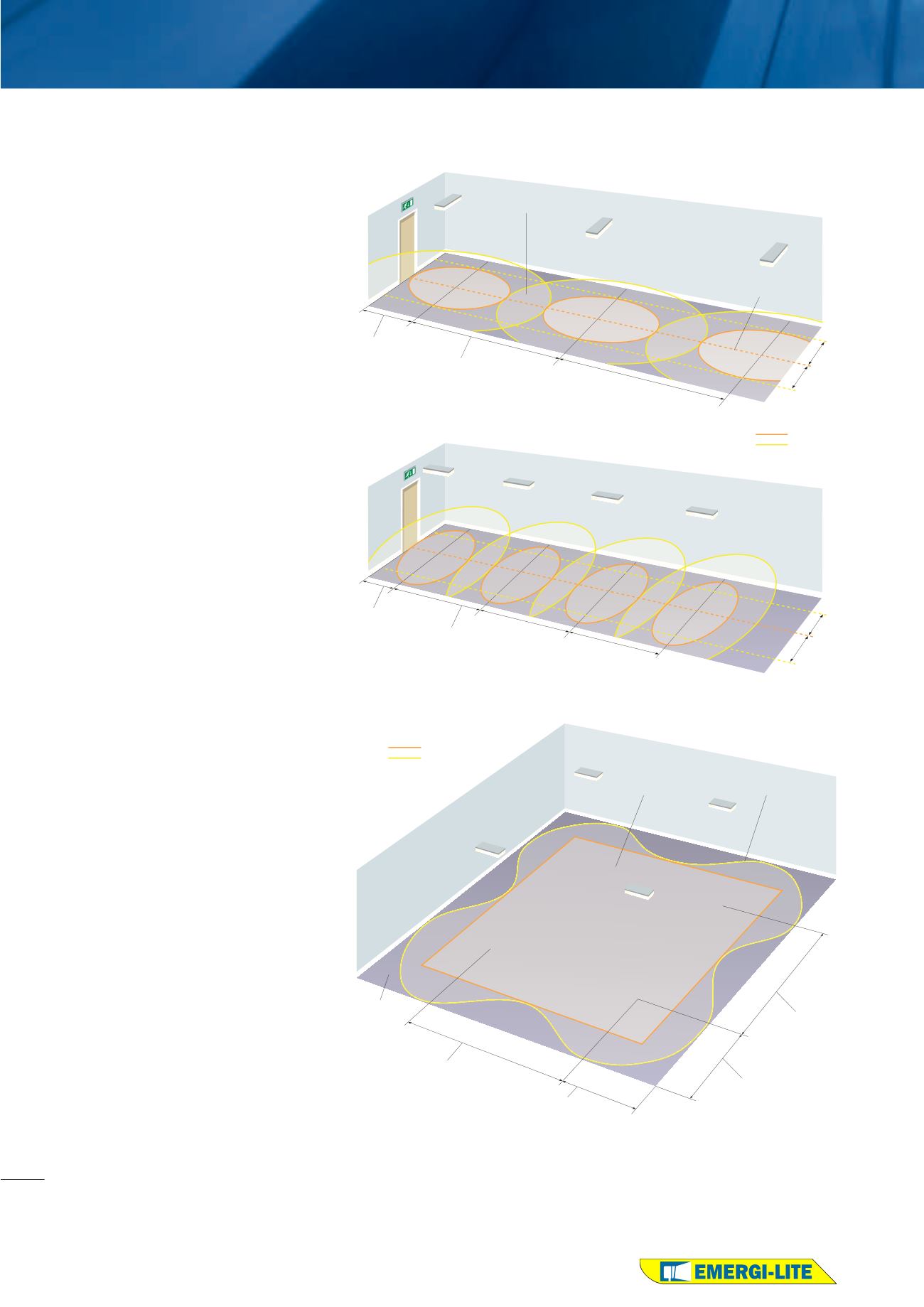
A defined escape route of 2 m width
must be illuminated to a minimum of
1 lux along the centre line
(see right)
.
Open areas (anti panic)
Open areas must be illuminated to
0.5 lux minimum in the core area
(see below right)
. This also applies to
areas with undefined escape routes, in
halls or areas greater than 60 m
2
.
High risk task areas
This refers to areas normally associated
with moving machinery, dangerous
materials or processes, and other areas
of high risk where hazards may
continue after mains lighting failure.
Illuminance levels should be maintained
at 10% (or over) of the normal lighting
level or 15 lux, provided within
0.5 seconds, to allow for safe egress
and/or termination of processes. For
high risk task areas, the lux requirement
is calculated at the plane of the task
rather than floor level.
Additional areas
Additional areas not part of the escape
route still require illumination as people
may be located there and/or measures
may be required to ensure the safety of
persons or processes. These areas
include kitchens, first aid/operating
rooms, lifts, refuge areas, escalators and
moving walkways, toilets larger than
8 m
2
(or smaller without borrowed
light), disabled toilets, small lobbies
and pedestrian routes within covered
car parks.
Luminaire mounting height
Emergency luminaires should be
mounted at least 2 m above the floor.
There is no upper limit but luminaires
should be fitted below smoke level if
there is a significant risk of floor
illumination being affected.
System integrity
All compartments should include two or
more emergency luminaires to counter
the risk of emergency luminaire failure.
Stand-by lighting
If stand-by lighting is used as emergency
lighting it should conform to all the
requirements of emergency lighting.
Transverse spacing
to wall
Escape route with
transverse luminaires
Transverse spacing
between luminaires
Axial spacing
to wall
Axial spacing
between luminaires
0.5 lux + 0.5 lux
= 1.0 lux
1.0 lux min. on centre
line of escape route
1.0 lux
Escape route with
axial luminaires
0.5 lux
0.5m
0.5m
0.5m
0.5m
Transverse spacing
to wall
0.5 Lux Isolux
covering core area
Transverse spacing
between luminaires
Axial spacing
to wall
Axial spacing
between luminaires
Core area
0.5 lux
Core area
0.5m border
0.5 Lux Isolux curve
outside the core area