




 309 / 319

2
It is now standard practice
to use luminaire supporting
couplers (LSC), such as
Klik from Hager, when
designing and installing
commercial lighting
installations. Designers,
inspecting engineers and
electrical contractors often
misunderstand key areas of
specification for compliance
with the BS 7671 wiring
regulations for LSCs.
Q
What product standards
do the Wiring Regulations
specify for LSCs?
Regulation 511.1 says that
equipment should “comply
with the relevant requirements
of the applicable British
Standard or harmonised
standard.”
Appendix 1 of the regulations
identifies BS 6972 as the
specification for general
requirements for luminaire
supporting couplers for
domestic, light industrial
and commercial use. It gives
general requirements for the
construction of LSC plugs and
LSC outlets with particular
reference to safety. LSCs must
comply with either BS 6972 or
BS 7001.
Q
Where exactly can LSCs
be used?
Referring to BS 6972, LSCs
are for use in final circuits
rated at not more than 16 A,
where the supply voltage does
not exceed 250 V ac and the
electrical load connected to
any one LSC plug does not
exceed 6 A.
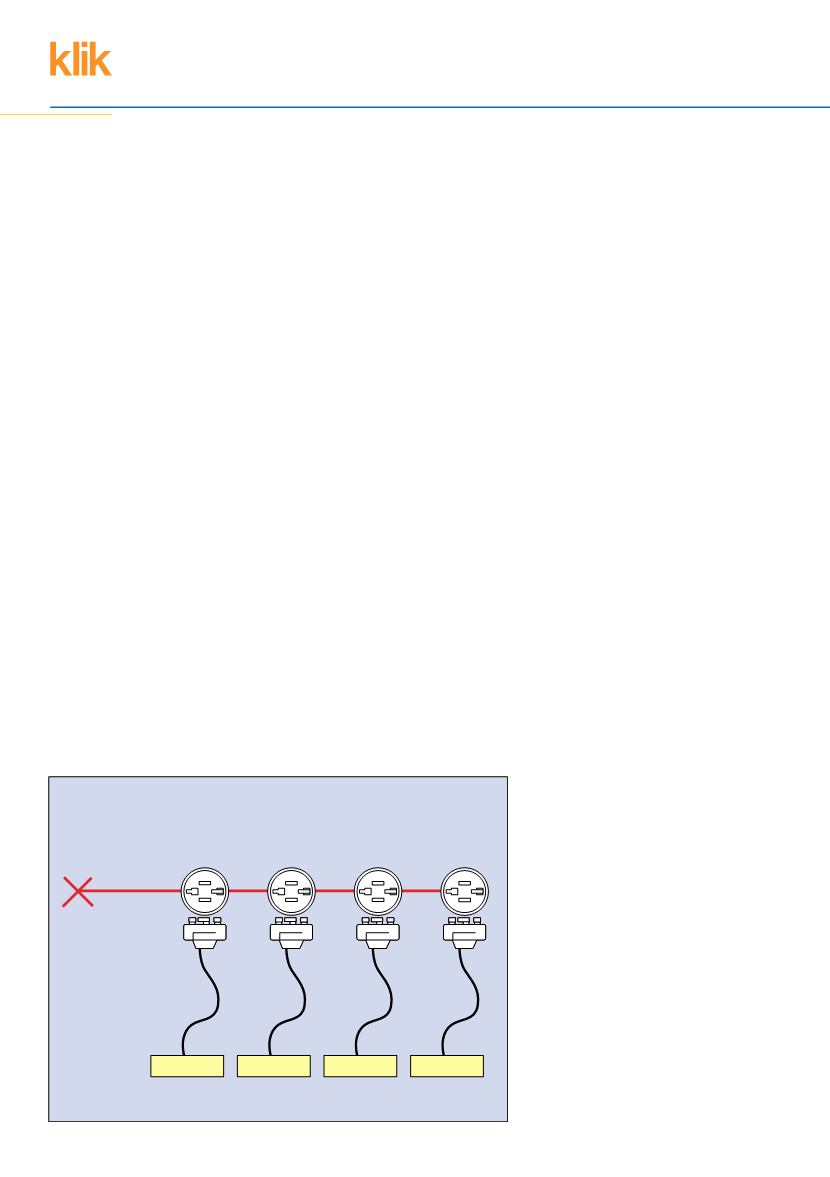
BS 6972 also specifies the
conductor cross sectional
area of the flexible cord for
LSC plugs which are not part
of the luminaire as between
0.5 mm
2
to 1.00 mm
2
(see
figure 1).
Q
How can you use a 16 A
circuit breaker when the LSC
plug and flexible cord are
rated at 6 A?
To best answer this, we
need to split the question
into three parts. Firstly, how
is overcurrent defined?
Overcurrent is defined as
overload currents or fault
currents.
Second, how do you define
overload current? Overload
current is an overcurrent
occuring in a circuit that is
electrically sound. An example
might be a user plugging in
more appliances than the
circuit is intended for, which
may in turn cause an overload.
The designer needs to decide
if a circuit is liable to carry
overload current. It is clear
in figure 1 that the circuit
cable with 2.5 mm
2
conductor
requires overload protection.
In this instance the user may
plug in additional luminaires
and create higher power
consumption than the circuit
is intended for.
Finally, can overload
protection be omitted? There
are some conditions where
overload protection is not
necessary. Regulation 433.3.1
(ii) tells us that overload
protection is not necessary for
a conductor, which, because
of the characteristics of the
load, is not likely to carry
overload current.
In figure 1 we can assume
that the LSCs and their 0.75
mm
2
flexible cord supplying
Conductor size
Figure 1: An example of a specification of flexible
cord for LSC plugs
Flexible
cord with
0.75 mm
2
conductor
Individual luminaire (load current = 3A)
2.5 mm
2
"kilK" A 6
rotcudnoc
16 A
type C
circuit
breaker