




 509 / 543

Circuit-breakers, fuses
Miniature circuit-breakers (MCB)
2010 CA08103002Z-EN
www.eaton.com19/55
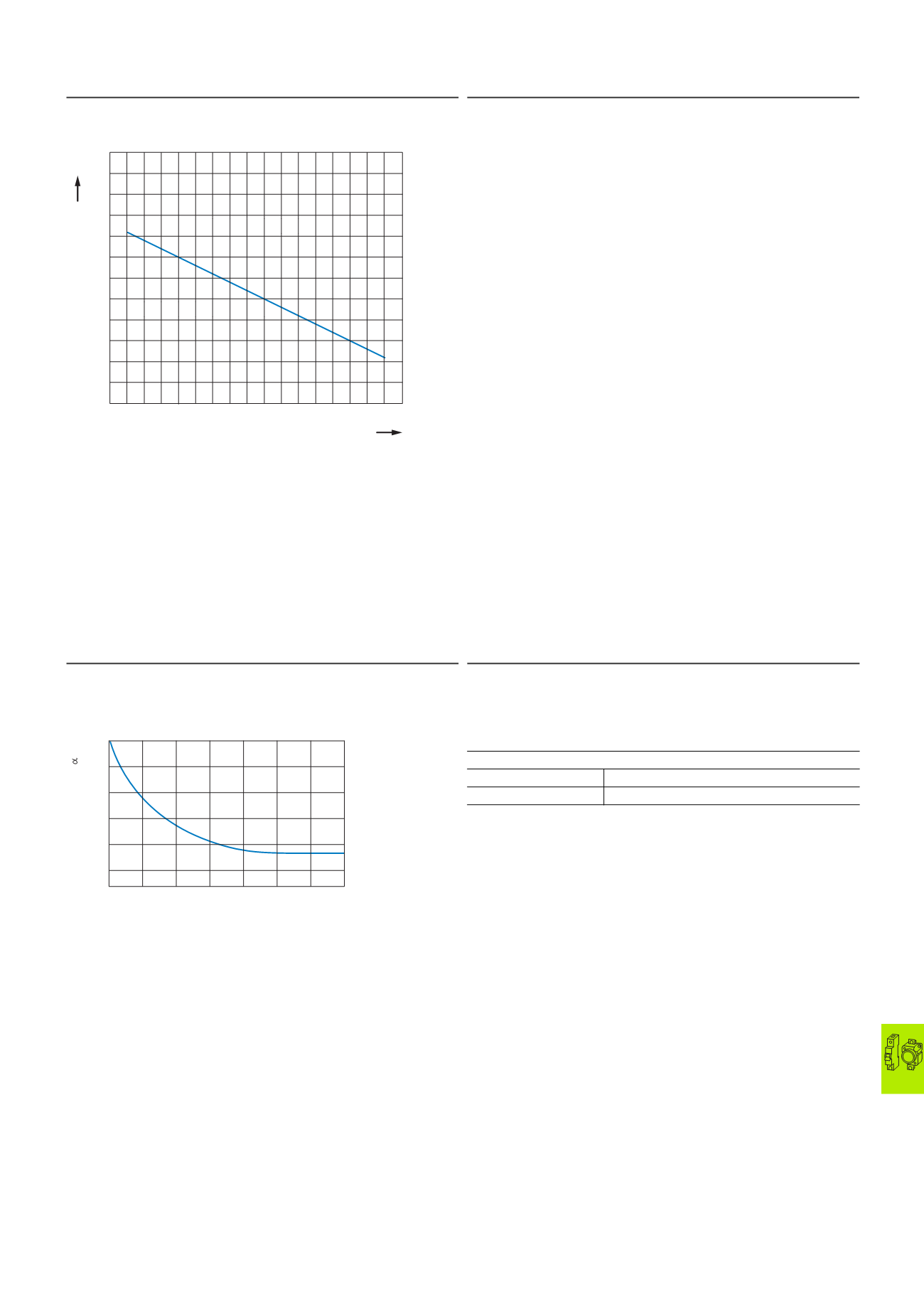
Influence of the ambient temperature on the tripping behavior
PDIM leakage current meters
FAZ-...-NA, FAZ-...-RT,
Contour and rail mounting compatible with other devices of the P series
Freely selectable rail arrangement top and bottom
Free terminal compartment despite fitted busbar
Power supply through ordering of the four conductors
Electronic operation (independent of mains voltage)
Mains connection on either side.
The 4 pole switch can also be used as 3 pole switch.
To do this, use terminals 1-2, 3-4 and 5-6.
The 4 pole switch can also be used as 2 pole switch.
To do this, use terminals 5-6 and N-N.
2 relays (N/O, parallel to yellow and red LED), floating
(up to 10 A/230 V∼)
Function
Green LED lit on 0 – 30 % of set I
Δn
.
Yellow LED lit on 30 – 50 % of set I
Δn
.
Red LED lit on > 50 % of set I
Δn
.
The yellow LED goes out when tripped if the measured fault current < 30 % of
the set I
Δn
.
The red LED goes remains lit when tripped, even if when the measured fault
current < 50 % of the set I
Δn
.
The red LED goes out only when the Reset button is pressed.
Only one LED lights up at any one time.
An output relay is always connected parallel to the yellow or red LED.
Depending on the set RCCB (non-delayed, G, or S) the fault current must flow
for a specific time before an action takes place.
Test function
Rotary coding switch for RCCB function set to “TEST”.
A fault current of 30 % and 50 % I
Δn
is simulated in alternation.
The yellow and red LED flash alternately (1 Hz); both output relays are
continually picked up.
K
T
= rated diversity factor
Load carrying capacity with side-by-side miniature circuit-breakers
FAZ...
Influence of the mains frequency
Influence of the mains frequency on the tripping behavior I
MA
of the
instantaneous release
Mains frequency f [Hz]
16 ⅔ 50 60 100 200 300 400
I
MA
(f)/I
MA
(50 Hz) [%]
91 100 101 106 115 134 141
50
40
30
20
10
0
-10
-20
0.90
1.40
1.30
1.20
1.10
1.00
K
T
[I/I
n
]
°C
1
2
3
4
0.70
0.80
0.90
1.00
5
6
7
8
Number of circuit-breakers
Rated diversity factor
FAZ, FAZ-NA, FAZ-RT, PDIM