



 25 / 582

BETA Protecting
Miniature Circuit Breakers
5
SP and 5SY miniature circuit breakers
1/3
Siemens ET B1 · 10/2008
1
*
You can order this quantity or a multiple thereof.
■
Overview
MCBs are used to protect plants in buildings and for industrial
applications. The devices can be used as main switches for the
disconnection or isolation of plants.
For industrial applications and in plant engineering, miniature
circuit breakers can be supplemented with additional components,
such as auxiliary switches, fault signal contacts, shunt trips,
undervoltage releases, remote controlled mechanisms and RC
units.
The devices are approved for worldwide use according to IEC
standards for systems up to 250/440 V AC. 60 V DC per pole is
permitted in DC systems.
For North America, we also have additional certification to
UL 1077 for use as "supplementary protectors" in systems up
to 480Y/277 V AC. For use in ship building, the devices have
numerous certifications according to shipping classifications BV,
DNV, GL and LRS. For further information, please refer to the
section "Configuration".
■
Benefits
•
The infeed can be either from the top or the bottom as the
terminals are identical.
•
Clear and visible conductor connection in front of the busbars
that can be easily checked.
•
Large and easily accessible wiring space enables easy
insertion of conductor in the terminal.
•
Integrated movable terminal covers located at the cable entries
ensure the terminals are fully insulated when the screws are
tightened.
•
The effective touch protection when grasping the device
considerably exceeds the requirements of VBG 4/BGV A3.
•
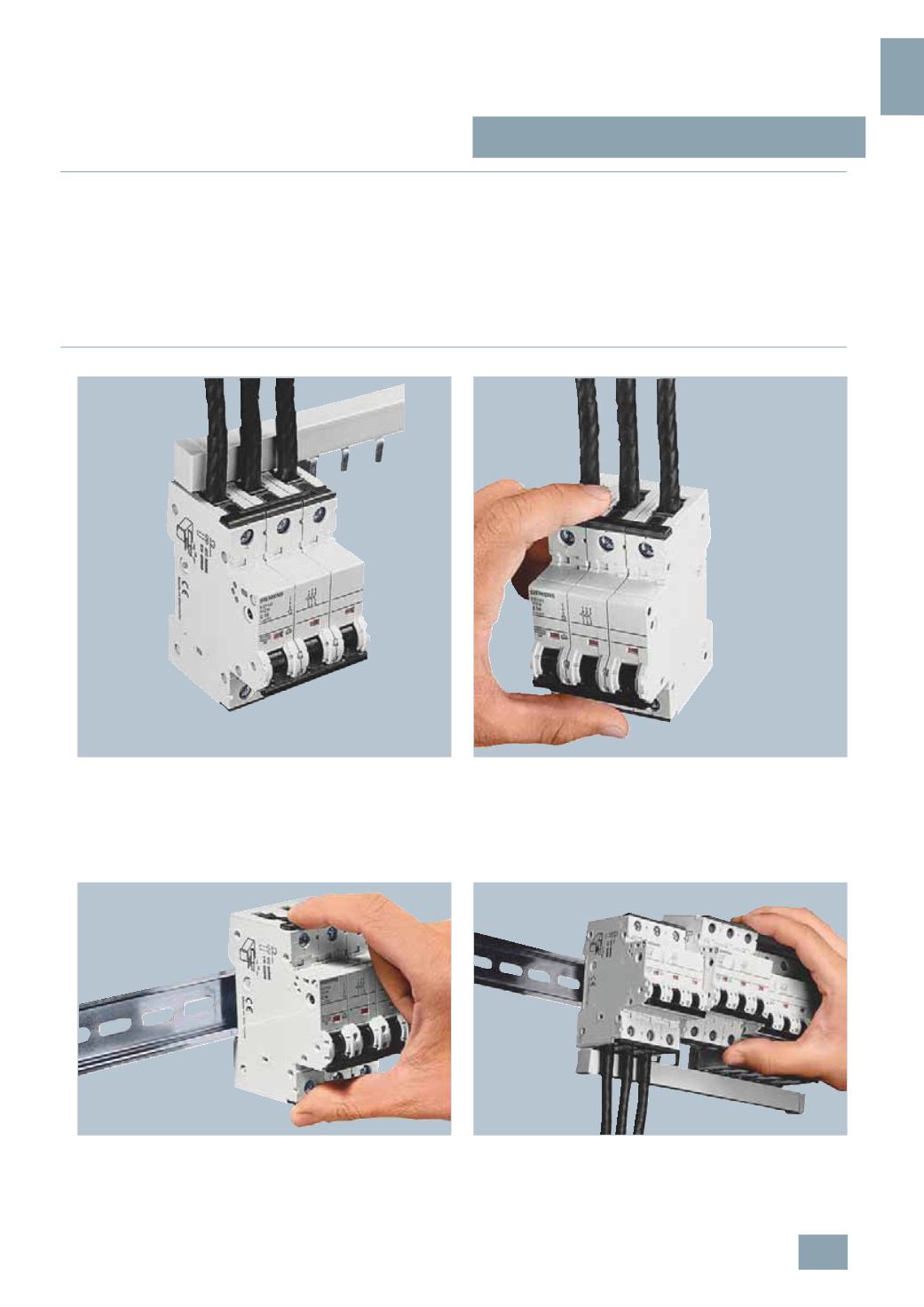
Manual snap-on fixing and release systems that require no
tools enable fast assembly and disassembly of MCBs.
•
Highlighted labeling field on all modular installation devices
for uniform, quick and simple labeling.
•
The MCBs can be quickly and easily removed from the busbar
assembly by hand, e.g. if connections need to be changed.
•
Time saving if parts need to be replaced because the busbars
no longer need to be freed from the adjacent devices.
© Siemens AG 2008