



 111 / 582

BETA Protecting
Residual Current Protective Devices
5
SM3 RCCBs, type A
2/3
Siemens ET B1 · 10/2008
2
*
You can order this quantity or a multiple thereof.
■
Overview
RCCBs of type A are used in all systems up to 240/415 V AC.
They trip in the event of both sinusoidal AC residual currents and
pulsating DC residual currents.
RCCBs with a rated residual current of maximum 30 mA are used
for personnel, material and fire protection, as well as for additional
protection against direct contact. RCCBs with a rated residual
current of 10 mA are primarily used in areas that represent an
increased risk for personnel.
Since DIN VDE 0100-410 came into effect in June 2007, all
socket outlet current circuits up to 20 A must now also be fitted
with residual current protective devices with a rated residual
current of max. 30 mA. This also applies to outdoor electrical
circuits up to 32 A for the connection of portable equipment.
Devices with a rated residual current of maximum 300 mA are
used as preventative fire protection in case of insulation faults.
RCCBs with a rated residual current of 100 mA are primarily
used outside Europe.
SIGRES
SIGRES RCCBs were developed for use in harsh ambient conditions,
such as swimming baths, as protection against chlorine and
ozone, in the agricultural sector (ammonia), on building sites
and in the chemical industry (nitrogen oxide, sulfur dioxide,
solvents), in the food processing industry (hydrogen sulfide) and
in unheated rooms (dampness). The patented active condensation
protection requires the infeed from below with the RCCBs
switched off.
Super resistant
æ
Super resistant (short-time delayed) RCCBs meet the maximum
permissible break times for instantaneous devices. However, by
implementing a short-time delay they prevent unnecessary
trippings, and thus plant faults, when pulse-shaped leakage
currents occur – as is the case when capacitors are switched on.
Selective
î
Can be used as upstream group switch for selective tripping
contrary to a downstream, instantaneous or super resistant
RCCB.
■
Benefits
•
Instantaneous RCCBs with the N connection on the left-hand
side enable simple bus-mounting with standard pin busbars
with miniature circuit breakers installed on the right-hand side
•
Instantaneous RCCBs with the N connection on the right-hand
side can be bus-mounted with MCBs using a special pin busbar
•
Instantaneous devices have a surge current withstand capability
with current waveform 8/20 s of more than 1 kA, super resistant
of more than 3 kA and selective of more than 5 kA. This ensures
safe operation
•
SIGRES has an extremely long service life due to patented
active condensation protection and the same dimensions for
fast and simple exchange of already installed instantaneous
RCCBs
•
Super resistant devices increase plant availability, as
unnecessary tripping is prevented in systems with short-time
glitches
•
Selective RCCBs increase plant availability, as in the event of
a fault, a staggered tripping time enables the selective tripping
of series-connected RCCBs
•
Auxiliary switches or remote controlled mechanisms are also
available as additional components
•
The operating handle and the test button can be locked by
means of a handle locking device.
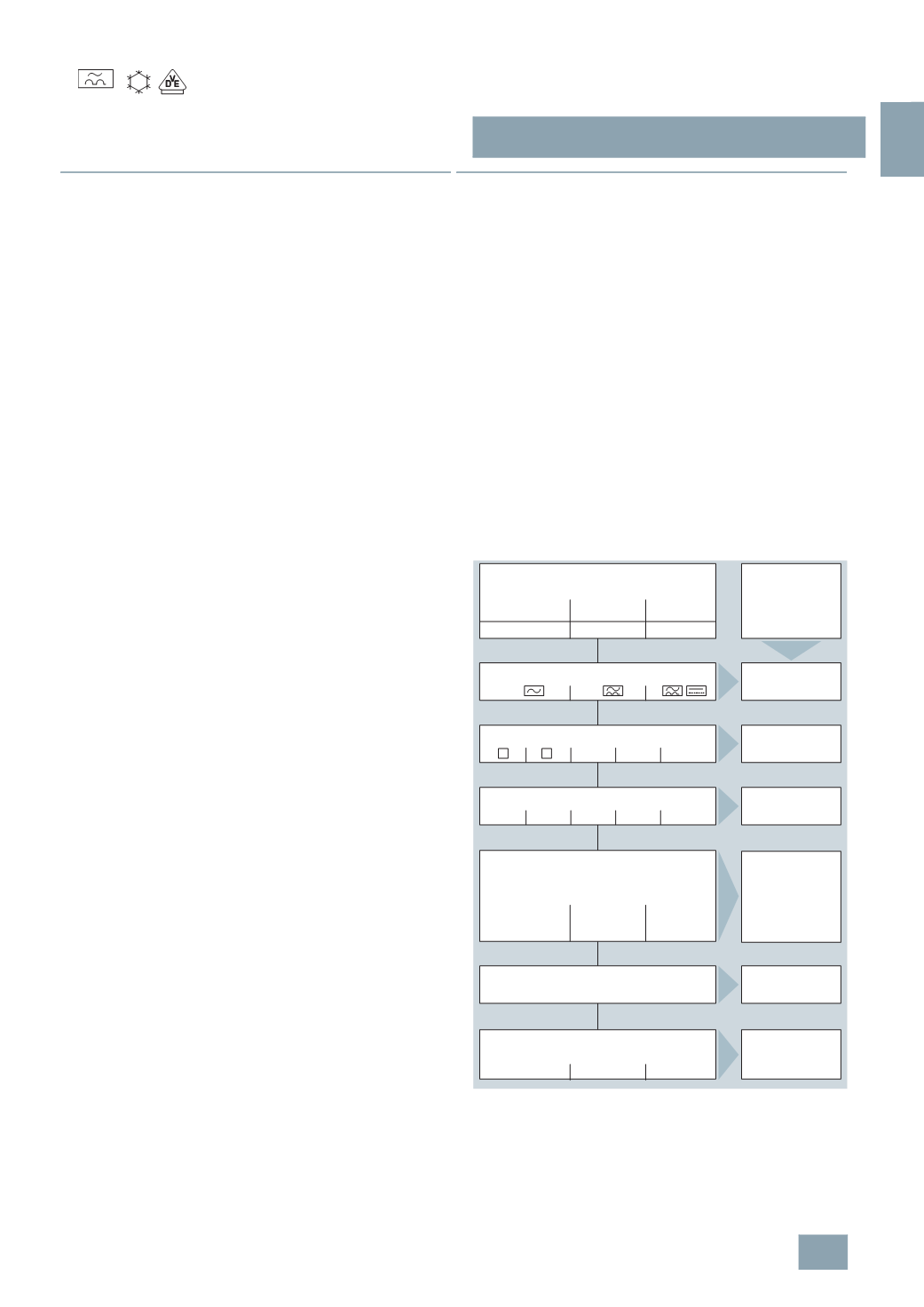
Selection aid for determining a suitable residual current protective device
RCCB
RCBO
SIGRES 500 V 50-400 Hz
RC unit
K
S
A
B
AC
3
+N
1
+N
4
2
B
C
D
3
I2_15509
Design
RCCB
RC unit
RCBO
Selection
criterion
Type
Equipment circuit,
load current,
residual current
System, equipment,
ambient conditions
Equipment
Version
Number of poles
Additional
protection
I
∆n
≤ 30 mA
Fire
protection
I
∆n
≤ 300 mA
Trip conditions
limited
I
∆n
Installation
regulation
VDE 0100-410
Rated residual current
I
∆n
protection objective
-530
-7
xx
-482
Equipment
Rated current
I
n
Trip conditions acc.
to VDE 0100-410
Equipment
Only with RCBOs with
MCB characteristic
-25
(
Type A)
© Siemens AG 2008