Basic HTML Version




8/101
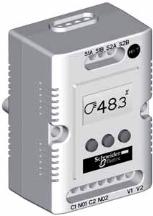
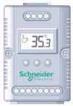
Electronic hygrothermwith LCD screen
● Electronic temperature and humidity controller.
● Input voltages: 9-30 V, 110-127 V and 220-240 V.
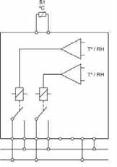
● Hygrotherm with 2 independent switching relays (ventilation / heating function).
● Thermostat precision: +/–1.5 °C.
● Hygrostat precision: +/–5% RH, relative humidity.
● Option of installing external PTC sensors, ref.
NSYCCAST
, for remote reading
(L = 3 m).
● PC plastic material, self-extinguishing according to standard UL94 V0.
● Option of displaying the temperature in degrees Celsius °C or Fahrenheit °F.
Display Voltage Type of current
Max. command
intensity
Reference
°C or °F
% RH
9-30 V
AC DC
8 (5) A 230 V AC /
5 A 30 V DC
NSYCCOHYT30VID
110-127 V
AC
NSYCCOHYT120VID
220-240 V
NSYCCOHYT230VID
Technical features
Operating temperature
0 °C…+50 °C
Temperature setting range
+5 °C…+50 °C
Humidity setting range
20%…80%
RH hysteresis
3%
Connection
2 2.5 mm
2
(input voltage) + 2 relays (2 2.5 mm
2
+
2 2.5 mm
2
)
Contact
Free with zero potential
Mounting
4 different methods: by DIN rail, Spacial SF profile, on VDI
cross-rail or on mounting plate
Enclosure
UL94-V0 plastic, light grey
Certification
UL / UR
Mode 1
Relay 1
Relay 2
Controlled device
Fan
Resistance heater
Measured variables
Temperature
Temp. (T) and humidity (RH)
Control type
Avoid high temperatures
Avoid low temperatures
Mode 2
Relay 1
Relay 2
Controlled device
Resistance heater
Alarm by switching
Measured variables
Control of the dew point
Temperature and humidity
Control type
Avoid high humidity
High humidity or
temperature alert
Mode 3
Relay 1
Relay 2
Controlled device
Fan
Resistance heater
Measured variables
External temperature -
Internal temperature*
Temperature (T) and
humidity (RH)
Control type
Heating by ventilation
Avoid low temperatures
*Comparison mode in relay 2: an external sensor is required for the comparison function (Text - Tint).
Example of mode 3: Decides whether the external temperature is favourable and controls the
ventilation (Relay 1) or heating (Relay 2).
Advantage of mode 3: Energy efficiency. Option of efficiently heating the enclosure by ventilation
(using hot external air) before bringing the resistance heater into operation. The thermostat
automatically detects any connected sensors.
Operating modes
L
N
Load1
Load2
L
N
Load1
Load2
S1
ºt
S1A S1B
NO1 C1 C2 NO2
L N
S1ºt
L
N
Load1
Load2
NO1
C1 C2 NO2
L N
Load (1) = fan/resistance
Load (2) = fan/resistance/alarm
08_101_102_CC008.indd 101
29/1